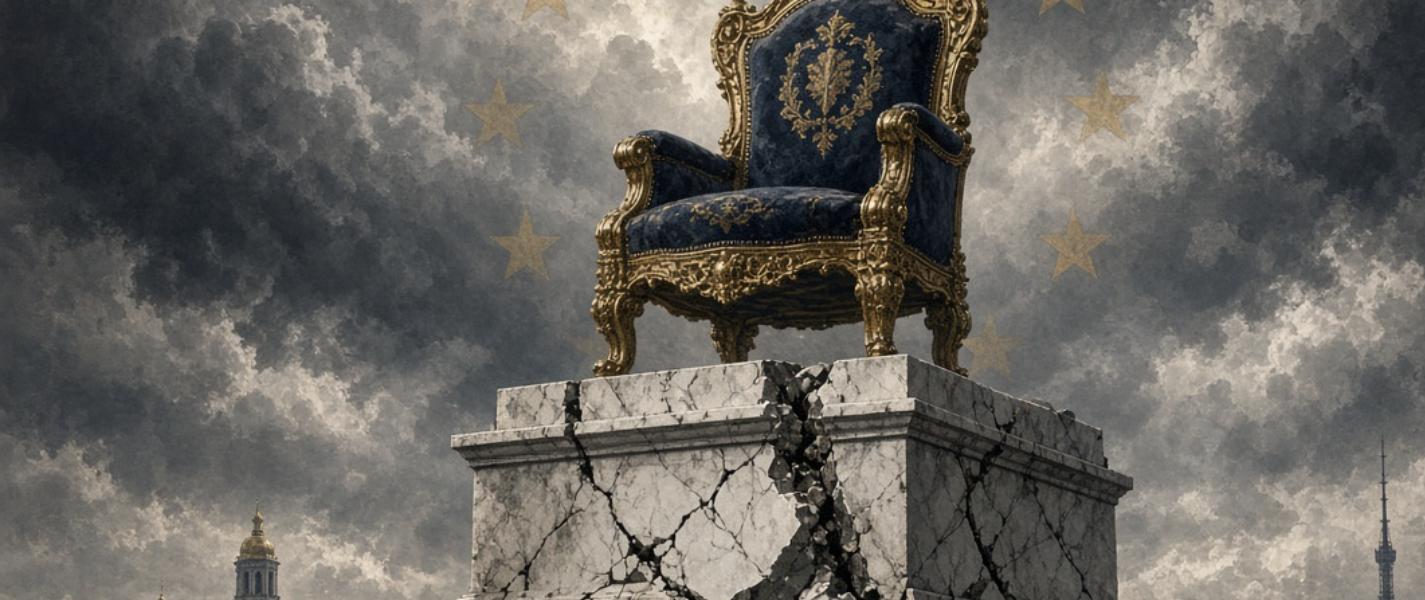
Analysis. The facts below are attributed to their sources; the projections are analytical scenarios, not established facts. President Zelensky faces no criminal charges.
TL;DR: Within days, Ukraine’s presidency absorbed an anti-corruption operation inside its own office (the August 19 arrest of deputy chief of staff Iryna Mudra), a public call by a dismissed minister for wartime elections, and a reignited debate over a mandate that nominally expired in May 2024. Add sliding polls, the July 2025 precedent of a president forced to back down, and €90 billion in conditional EU aid, and a plausible endgame scenario emerges. Plausible — not inevitable.
August 19: the probe reaches the top floor
Facts first. On August 19, 2026, NABU and the anti-corruption prosecutor’s office launched Operation “Forrest Gump”: morning searches at the top of the state, a one-sentence dismissal decree by evening, and the overnight arrest of Iryna Mudra — the deputy head of the Presidential Office in charge of judicial reform — on money-laundering charges (Euronews, Kyiv Post). Investigators allege 150 million hryvnias laundered through shell companies, with tapes implicating MP Vadym Stolar and ex-MP Maksym Mykytas in a corporate-raiding scheme worth over 248 million hryvnias (Kyiv Independent). All are presumed innocent. But politically, this is the second time in a year — after November 2025’s “Midas” scandal — that investigators have reached the inner circle; Poland’s OSW think tank calls it exactly that.
The July 2025 precedent: a president who can be forced to fold
The current fragility has a genealogy. In July 2025, Zelensky signed a law subordinating NABU and SAPO to the prosecutor general — triggering the first mass protests since the invasion and warnings from Brussels. He reversed course within ten days. The polling cost was immediate: trust fell from 65% to 58% per KIIS, with the trust balance dropping from +35 to +23 (Kyiv Independent). After “Midas,” another poll put his vote share at just 20%. A president the street has already bent once is no longer untouchable — and everyone in Kyiv knows it.
Serial dismissals — and what critics say they mean
Mudra’s instant firing caps a year of dismissals and reshuffles. The office’s version: decisiveness. The critics’ version: pruning branches to protect the trunk. Dismissed minister Mykhailo Fedorov escalated dramatically on August 19, decrying a “systemic crisis of governance” and calling for wartime presidential elections — a challenge CNN says strikes “at the heart of Zelensky’s vulnerabilities.” Some opposition figures and commentators go further, casting the dismissals as a leader trying to save his own position. That is their interpretation, reported here as such — not an established fact. Yet the fact that such readings are now voiced from within the former ministerial ranks is itself a symptom.
The constitutional question that won’t go away
Then there is the legal elephant in the room. Zelensky’s five-year term nominally expired in May 2024; martial law, in force since 2022 and repeatedly extended, suspends elections. Two legal readings collide. The dominant Ukrainian view: constitutional continuity applies while martial law lasts, and voting under missile fire is physically impossible. The opposing view, pressed by opponents and foreign commentators: four years without elections, suspended parties, and constrained media add up to an accumulating legitimacy deficit (Time, Freedom House). Zelensky insists elections will follow a ceasefire and security guarantees (Euronews). Every new scandal makes that promise harder to defer.
Brussels holds the purse — and the leverage
The decisive constraint is financial. The EU’s €90 billion loan for 2026–27 — backed by the EU budget and therefore by European taxpayers, many facing austerity at home — is explicitly conditioned on rule of law and anti-corruption progress. War-weary European publics will not indefinitely accept top-level scandals in the state their taxes underwrite. Conditionality, so far theoretical, could become the instrument that decides Kyiv’s political future.
Endgame: a scenario, not a verdict
So — final weeks, final months? Framed properly, as analysis: Zelensky’s hold on power is not doomed, but it has become conditional. If the next wave of investigations reaches his last defenses — chief of staff Andriy Yermak’s premises were already searched in late 2025 — if the street replays July 2025 at scale, and if Brussels freezes even one tranche, the squeeze of scandal, legitimacy, and money could close within months. Conversely, the war remains his strongest shield: no viable challenger, no possible ballot, and a rally-round-the-flag reflex after every Russian strike. The endgame scenario is on the table. It is not yet written.
FAQ
Does this article claim Zelensky is about to fall?
No. It analyzes documented signs of weakness and lays out a conditional scenario. No fall is announced or established.
Is Zelensky charged with any crime?
No. No charges target the president. Those prosecuted — including his former deputy chief of staff — are presumed innocent.
Who says the dismissals are about “saving himself”?
Opposition figures and commentators; dismissed minister Fedorov speaks of a “systemic crisis of governance” and demands elections. These are attributed interpretations, not established facts.
Why hasn’t Ukraine held elections?
Martial law has suspended elections since 2022. The dominant legal reading holds the mandate legally continues; critics dispute the resulting legitimacy. Zelensky ties any vote to a ceasefire and security guarantees.
By Patrick Lancier