Category: Breaking News

  • BNP Paribas faces trial demand in Bongo family “ill-gotten gains” laundering case

    BNP Paribas faces trial demand in Bongo family “ill-gotten gains” laundering case

    TL;DR. On 27 July 2026, France’s National Financial Prosecutor’s Office (PNF) formally requested that 23 individuals and entities stand trial in the Gabonese chapter of the long-running “biens mal acquis” (ill-gotten gains) affair — among them BNP Paribas, under formal investigation since 2021 for aggravated laundering of the proceeds of corruption and embezzlement. At least €35 million is alleged to have flowed through the Gabonese company Atelier 74 into French property deals benefiting the family of the late president Omar Bongo. The bank contests any criminal liability. Investigating judges must now decide whether the case goes to trial; the presumption of innocence applies.

    What the prosecutors are asking for

    The PNF’s filing seeks a criminal trial for five companies — including BNP Paribas — and eighteen individuals, among them several children of Omar Bongo and Antoinette Sassou Nguesso, wife of Congo-Brazzaville’s president, as reported by AML Intelligence and Financial Afrik.

    The alleged money trail

    Investigators say that between 1996 and 2008, at least €35 million traceable to corruption and embezzled public funds in Gabon moved through the company Atelier 74 before being invested in French real estate for the Bongo clan. Prosecutors want BNP Paribas judged for its alleged part in those flows. Contacted by OCCRP, the bank said: “We contest any criminal liability of BNP Paribas in this case.”

    A crowded legal docket

    The request lands as the bank fights on other fronts: on 23 August 2026 it filed its appeal brief against the US jury verdict holding it liable for enabling atrocities in Sudan; it pleaded guilty in 2014 to US sanctions violations ($8.97 billion); and its record is chronicled in “What the courts actually say — from Sudan to the CumCum files”.

    What happens next

    The investigating judges can follow the prosecutors, dismiss the case, or split the difference. If they order a trial, it would be the first time a major French bank stands in criminal court in the two-decade ill-gotten-gains saga. No hearing date exists at this stage.

    Sources

    AML Intelligence, July 2026 · OCCRP · Financial Afrik · franceinfo (FR).

    FAQ

    Has BNP Paribas been convicted in the Bongo case?

    No. Prosecutors have requested a trial for aggravated money laundering; investigating judges have not yet ruled. The bank, under formal investigation since 2021, contests any criminal liability and is presumed innocent.

    What are “ill-gotten gains” cases?

    French investigations into luxury assets acquired in France by foreign ruling families with funds suspected to stem from corruption or embezzlement. The Gabonese chapter targets the family of Omar Bongo.

    How much money is involved?

    At least €35 million is alleged to have moved through the company Atelier 74 into French property purchases between 1996 and 2008.

    Is this connected to the Sudan verdict?

    Not procedurally — one is a US civil case, the other a French criminal investigation. Both, however, question the bank’s compliance controls over overlapping periods.

    By Patrick Lancier


  • BNP Paribas Sudan verdict: US jury holds bank liable for enabling atrocities — appeal now under way

    BNP Paribas Sudan verdict: US jury holds bank liable for enabling atrocities — appeal now under way

    TL;DR. On 17 October 2025, a federal jury in New York held BNP Paribas civilly liable for knowingly assisting Sudan’s government under Omar al-Bashir while it committed international crimes against civilians, awarding more than $20 million to three Sudanese refugees. The case was decided under Swiss law because the bank ran its Sudan business through Geneva. On 23 August 2026, the bank filed its opening appeal brief, alleging errors of law and excluded evidence, backed by amicus submissions including the Swiss and US governments. Liability stands at first instance; the appeal is pending.

    A first-of-its-kind verdict against a global bank

    The case is Kashef v. BNP Paribas S.A., No. 1:16-cv-03228, before Judge Alvin K. Hellerstein in the US District Court for the Southern District of New York. After nine years of litigation, the jury found that France’s largest bank consciously assisted the Sudanese government as it committed violent crimes against civilians between 2002 and 2008 — the height of the Darfur conflict, which the United States formally described as genocide in September 2004. The jury awarded roughly $20.75 million to three plaintiffs — Entesar Osman Kashef, Abulgasim Abdalla and Turjuman Adam — refugees now living in the United States who testified about the atrocities they survived.

    The full court record is public: Kashef v. BNP Paribas SA docket on CourtListener. Judge Hellerstein later denied the bank’s post-trial motions and entered judgment, finding the trial evidence gave the jury ample basis to conclude the bank’s conduct enabled the regime’s crimes. Plaintiffs’ counsel have moved for prejudgment interest that would lift the award above $40 million, and say the verdict opens a path for more than 20,000 Sudanese refugees in the US.

    Why Swiss law decided an American trial

    BNP Paribas ran its Sudanese operations out of its Geneva subsidiary, so the court applied Article 50(1) of the Swiss Code of Obligations — liability for knowingly cooperating in another’s unlawful act. Plaintiffs had to show the regime’s illicit acts, the bank’s conscious assistance (it knew or should have known it was contributing), and causation of their harm, under the Swiss “preponderant likelihood” standard set out in Judge Hellerstein’s 8 September 2025 opinion. Trial evidence described BNP Paribas as Sudan’s de facto banker — for years effectively its only gateway to international finance, handling flows in the tens of billions of dollars.

    The 2014 guilty plea that set the stage

    This civil verdict rests on an established record. In June 2014, BNP Paribas pleaded guilty in the US and agreed to pay $8.97 billion — then a record penalty — for processing billions of dollars for sanctioned Sudanese, Iranian and Cuban entities, per the Department of Justice announcement. We traced that thread in “BNP Paribas: what the courts actually say — from Sudan to the CumCum files”.

    23 August 2026: the bank’s appeal

    In a statement dated 23 August 2026, BNP Paribas said it had filed its opening brief with the US Court of Appeals seeking reversal. The bank argues the trial court “seriously misapplied Swiss law” and denied it the chance to present what it calls essential evidence that the transactions were permitted under Swiss and European law. It also points to amicus curiae submissions filed on 29 May by prominent third parties — including the Swiss and US governments, legal scholars and professional bodies — supporting its legal position. To be precise: civil liability was established at first instance; the bank contests it, and the appeal is pending.

    Why it matters beyond this case

    A jury holding a global bank financially answerable for a client regime’s atrocities is a warning shot for the whole industry — one more entry in a legal ledger that already includes the frozen Exane Intégrale UCITS fund and the sanctions history we detailed in our earlier investigation. Each time, the same question: where were the safeguards?

    Sources

    Court docket, Kashef v. BNP Paribas SA, 1:16-cv-03228 (S.D.N.Y.) — CourtListener · Hellerstein opinion, 8 September 2025 — Justia · Forbes, 19 October 2025 · Peters & Peters · Hausfeld (plaintiffs’ co-counsel) · US DoJ, 30 June 2014 · BNP Paribas statement, 23 August 2026 · BNP Paribas group position.

    FAQ

    What did the jury actually decide?

    That BNP Paribas is civilly liable under Article 50(1) of the Swiss Code of Obligations for knowingly assisting Sudan’s government while it committed crimes against civilians between 2002 and 2008, and must pay about $20.75 million to three plaintiffs.

    Is this a criminal conviction for genocide?

    No. It is a civil damages verdict. The genocide designation for Darfur was made by the US government in 2004; the jury ruled on the bank’s civil liability for assisting the regime’s crimes.

    Where does the appeal stand?

    BNP Paribas filed its opening appellate brief on 23 August 2026, arguing errors of Swiss law and excluded evidence, with amicus support including the Swiss and US governments. The appeals court has not yet ruled.

    How does the 2014 settlement relate?

    In 2014 BNP Paribas pleaded guilty and paid $8.97 billion for processing transactions for sanctioned Sudanese, Iranian and Cuban entities. The Kashef trial addressed the human consequences of those same financial channels.

    By Patrick Lancier


  • Israel’s ‘Brit Re’im’ Delegation Helps Rescue 17 After Colombia’s Deadly 7.4 Quake

    Israel’s ‘Brit Re’im’ Delegation Helps Rescue 17 After Colombia’s Deadly 7.4 Quake

    Two weeks after a magnitude-7.4 earthquake devastated western Colombia, Israel’s ‘Brit Re’im’ (‘Alliance of Brothers’) delegation is still working through the rubble of Cali. According to the joint statement by the IDF and Israel’s Foreign Ministry, its teams have helped locate and rescue 17 people.

    TL;DR

    • A magnitude-7.4 earthquake struck Colombia’s Chocó department on August 10, 2026 — the country’s deadliest since 1999.
    • UNGRD’s August 16 toll: 294 dead, ~320 missing, nearly 4,000 injured; later press tallies top 320 dead and 12,000 homes destroyed.
    • Israel deployed the 80-member ‘Brit Re’im’ mission (IDF Home Front Command, Defense and Foreign Ministries) from Nevatim Airbase on August 13.
    • The delegation says it helped locate and rescue 17 people at two collapse sites in Cali; five extra tons of medical supplies were flown in.
    • Colombia accepted rescue teams from only four countries: the US, Ecuador, El Salvador and Israel.

    Colombia’s strongest quake this century

    The quake struck at 7:34 a.m. on Monday, August 10, with its epicenter in the Chocó department. The shaking was felt as far as Ecuador and Panama, with heavy damage reported in Cali, Quibdó, Pereira and Manizales. Colombia’s national disaster agency (UNGRD) reported 294 dead, around 320 missing and nearly 4,000 injured as of August 16; subsequent press tallies exceed 320 dead. More than 12,000 homes were destroyed.

    80 Israeli rescuers at two collapse sites in Cali

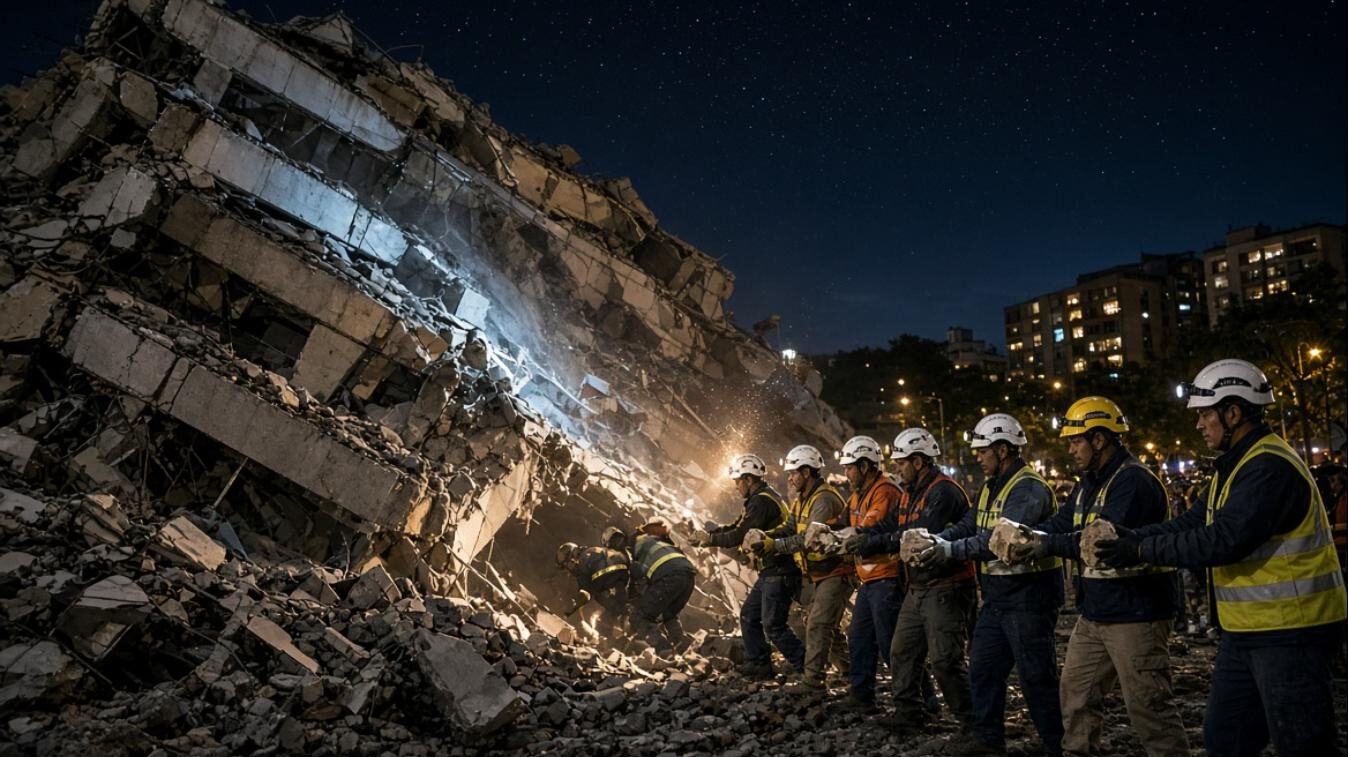
    Acting on Prime Minister Benjamin Netanyahu’s instructions and at the request of Colombian President Abelardo de la Espriella, Israel dispatched a joint IDF–Defense Ministry–Foreign Ministry delegation dubbed ‘Brit Re’im.’ The 80-member team, built around the IDF Home Front Command’s search-and-rescue units, departed Nevatim Airbase on the night of Thursday, August 13.

    “The delegation’s members are operating at two major impact sites and assisting efforts to locate and rescue trapped individuals, alongside numerous local volunteers,” the IDF said in a joint statement with the Foreign Ministry. The delegation says these operations have contributed to the location and rescue of 17 people, while its engineers map and assess unstable buildings. Israeli media report it is currently the largest international rescue team operating in Colombia.

    https://x.com/IDF/status/2087988913956851858

    Five more tons of medical aid

    Beyond search and rescue, Israel has shipped five additional tons of medical equipment to Colombia, i24NEWS reports, while the delegation distributes food and water parcels to displaced residents. Bogotá, meanwhile, has drawn criticism for accepting foreign rescuers from only four countries — the United States, Ecuador, El Salvador and Israel — a politically tinged filter widely debated in the international press.

    FAQ

    When did the earthquake strike Colombia?

    On Monday, August 10, 2026, at 7:34 a.m. local time. The magnitude-7.4 quake hit the Chocó department in western Colombia and was felt in Ecuador and Panama. Colombia’s geological service called it the country’s strongest this century.

    What is Israel’s ‘Brit Re’im’ delegation?

    ‘Brit Re’im’ (‘Alliance of Brothers’) is a joint mission of the IDF Home Front Command, the Defense Ministry and the Foreign Ministry — about 80 personnel who departed Nevatim Airbase on August 13 on the orders of Prime Minister Benjamin Netanyahu, according to the official IDF statement.

    What has the Israeli team achieved in Colombia?

    According to the joint IDF–Foreign Ministry statement, the delegation operates at two major impact sites in Cali alongside local volunteers. The delegation says it has helped locate and rescue 17 people, and its engineers are assessing damaged buildings. Israel also sent five additional tons of medical supplies, per i24NEWS.

    What is the death toll of the Colombia earthquake?

    Colombia’s disaster agency (UNGRD) reported 294 dead, roughly 320 missing and nearly 4,000 injured as of August 16; later press tallies exceed 320 dead, with more than 12,000 homes destroyed — Colombia’s deadliest quake since 1999.

    By Patrick Lancier

  • Type 1 Diabetes: The End of Insulin Injections May Be Within Reach With Zimislecel

    Type 1 Diabetes: The End of Insulin Injections May Be Within Reach With Zimislecel

    TL;DR: Zimislecel, Vertex Pharmaceuticals’ stem cell–derived islet therapy, freed 10 of 12 people with severe type 1 diabetes from insulin injections one year after a single infusion, according to phase 1/2 results published in the New England Journal of Medicine. A phase 3 trial is under way and regulatory filings are expected in 2026. The main trade-off today: lifelong immunosuppression.

    For millions living with type 1 diabetes, the end of insulin injections may finally be within reach. In a landmark trial published in the New England Journal of Medicine, a single infusion of zimislecel — lab-grown pancreatic islet cells developed by Vertex Pharmaceuticals — restored natural, glucose-responsive insulin production in nearly every participant.

    Lab-grown islets, delivered in one infusion

    Type 1 diabetes destroys the insulin-producing islet cells of the pancreas. Zimislecel replaces them: fully differentiated islets are manufactured from stem cells and delivered through a single infusion into the portal vein, where they settle in the liver and begin sensing glucose and secreting insulin on their own. Because the cells come from a donor line (an allogeneic therapy), patients must take immunosuppressive drugs to prevent rejection.

    What the trial showed in severe type 1 diabetes

    All twelve participants — adults with type 1 diabetes complicated by severe hypoglycemic events and impaired awareness of hypoglycemia — met recommended glycemic targets at one year (HbA1c below 7%, more than 70% time in range) and had no severe hypoglycemic events from day 90 onward. Ten of the twelve stopped external insulin entirely, most within six months of the infusion, and the group’s average daily insulin dose fell by 92%. Adverse events were mostly mild or moderate; two deaths occurred during the study, both judged unrelated to the therapy.

    The honest caveats

    Zimislecel is not approved anywhere yet, and this is not a validated “cure”: the published data cover twelve patients over one year. Lifelong immunosuppression — with its own infection and other risks — is currently unavoidable, which is why the therapy is aimed first at people whose severe, unrecognized hypoglycemia already puts their lives at risk. Nothing in these results changes today’s standard of care, and no one should adjust treatment without their medical team.

    Phase 3 and a 2026 regulatory horizon

    The phase 3 portion of the trial completed enrollment and dosing in the first half of 2025. Vertex plans to file for approval with the U.S. FDA, the European Medicines Agency and the U.K.’s MHRA in 2026, supported by accelerated pathways including RMAT and Fast Track (FDA), PRIME (EMA) and an Innovation Passport (MHRA). If the data hold, insulin independence could move from experimental result to approved option for the most severe forms of the disease.

    FAQ

    What is zimislecel?

    An investigational cell therapy from Vertex Pharmaceuticals: pancreatic islet cells grown from stem cells and given as a single infusion to restore natural insulin production in people with type 1 diabetes.

    Does it mean the end of insulin injections?

    Not yet. In the published trial, 10 of 12 participants stopped insulin at one year — a first at this scale — but the therapy is unapproved and initially intended for severe cases with hypoglycemia unawareness.

    What is the main drawback?

    Lifelong immunosuppressive treatment is required for now, because the infused cells come from a donor line. Reported side effects in the trial were mostly mild or moderate.

    When could it become available?

    Phase 3 is under way and Vertex expects to submit regulatory filings to the FDA, EMA and MHRA in 2026. Availability will depend on regulators’ decisions.

    Sources

    Par Patrick Lancier