Category: News

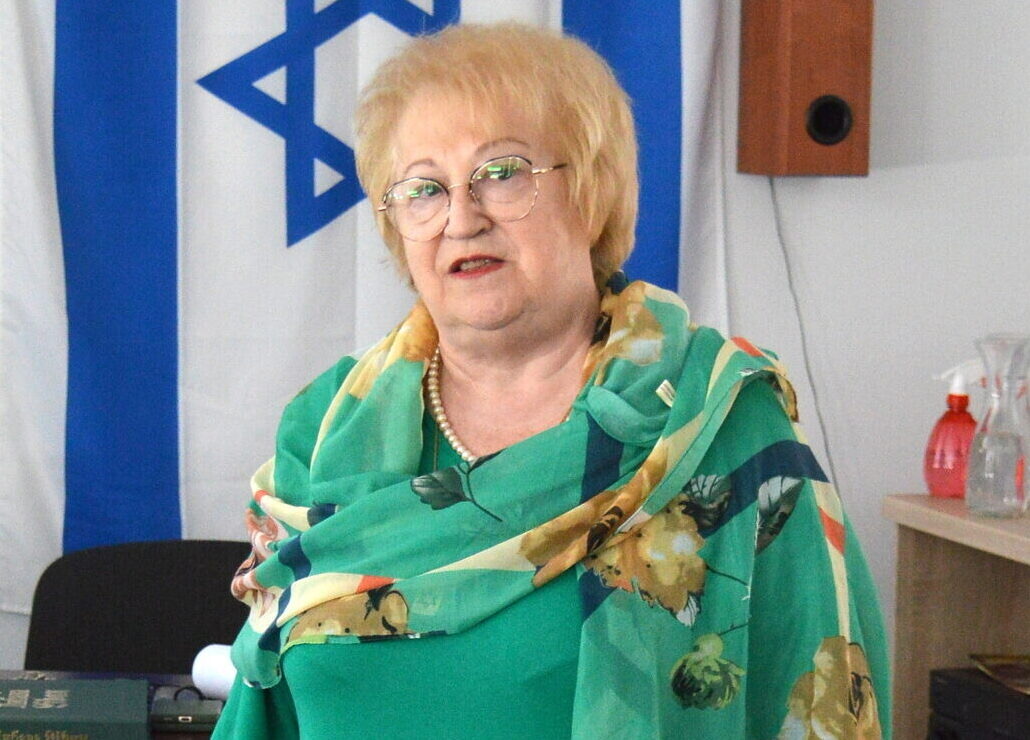
  • Ilana Ivanova at 80: Liepāja’s living Jewish memory

    Ilana Ivanova at 80: Liepāja’s living Jewish memory

    By David Nataf

    LIEPĀJA, Latvia — Ilana Ivanova (Zivson), whom I have long called “the soul of this community, a living memory”, is celebrating her 80th birthday. For decades she has been one of the driving forces behind the effort to save the memory of Jewish Libau, a community of nearly 6,000 people under Nazi occupation, of whom only around 30 who had been in the city at the time were still alive at liberation.

    Video: a memorial to the Jews of Central Europe unveiled in Liepāja (Uniting Fund, Facebook). Watch the video on Facebook

    On 8 October 2026, the restored memorial to the Jews from Central Europe who died in Liepāja was opened in the Jewish section of the city’s Livas Cemetery.
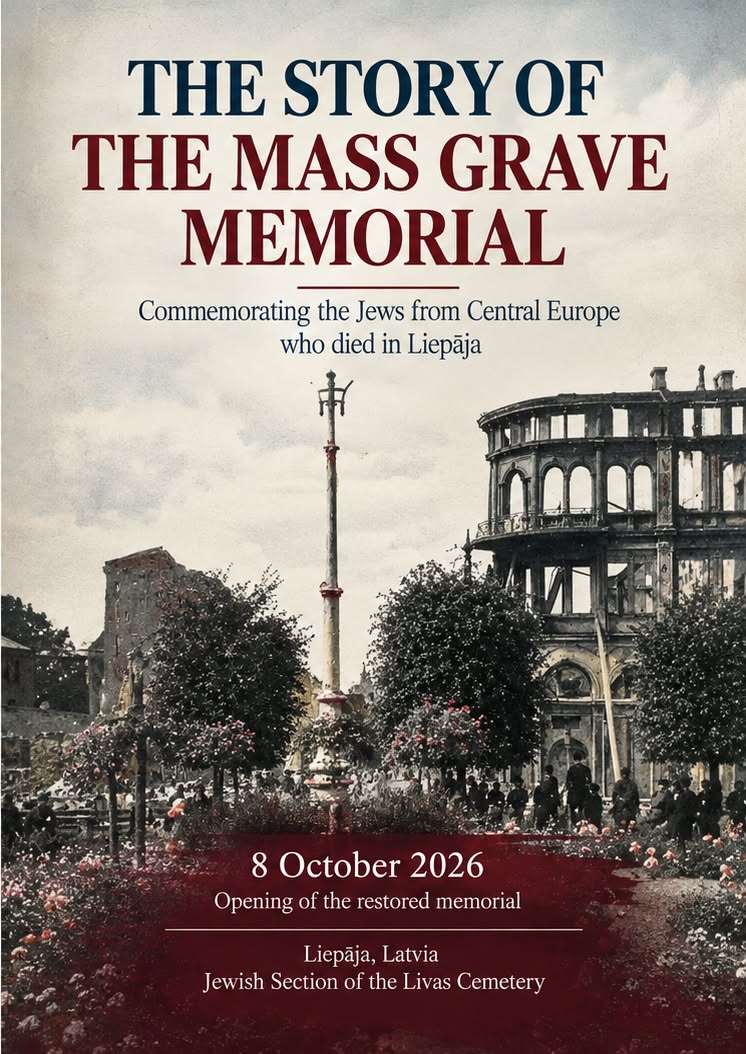
    Poster for the opening of the restored Mass Grave Memorial to the Jews from Central Europe who died in Liepāja, Livas Cemetery, 8 October 2026
    The Story of the Mass Grave Memorial: the restored memorial to the Jews from Central Europe who died in Liepāja opened on 8 October 2026 in the Jewish section of the Livas Cemetery.

    Her life’s work is described in a presentation on Jewish life in Liepāja today, written by her daughter, Anna Petrova, Chair of the Liepāja Jewish Religious Community. In it, Anna Petrova presents herself “not only as its leader, but also as a third-generation descendant of the Jewish Survivors of Liepaja”, adding: “I carry this history not only as part of our collective past, but as part of my own family story.”

    A family that survived, and kept the evidence

    Ilana’s parents, David and Henny Zivson, survived the Holocaust in Liepāja. They were among eleven Jews hidden by Roberts and Johanna Seduls in a concealed basement shelter, where they lived for nineteen months under constant threat of discovery. Roberts Seduls was killed by shrapnel shortly before liberation; Johanna went on caring for those in hiding until they were freed. Yad Vashem recognised Johanna Sedule as Righteous Among the Nations in 1981.

    David Zivson also preserved some of the most important evidence of the crime. Forced to work as an electrician for the German Security Service, he found photographs of the mass shootings at Šķēde in the office of SS commander Karl-Emil Strott and secretly made copies. According to the German Resistance Memorial Center, those copies were used as evidence at the Nuremberg and Grauel trials.

    Turning inherited memory into institutions

    Ilana inherited that memory and gave it a structure. According to her daughter’s presentation, she initiated and organised numerous historical, educational, cultural and international projects: the World Reunions of Liepāja/Libau Jewry, Holocaust memorial projects, conferences and exhibitions, the Otto Fischer initiative and historical publications, including the e-book The Jewish Heritage of Liepāja in the Context of the City’s History.

    “Her work has helped transform inherited memory into books, memorials, reunions, educational projects, and lasting institutions for future generations,” Anna Petrova writes.

    Much of this work has been carried out through the Liepāja Jewish Heritage Foundation, established in 2004. The Foundation has created memorials to the murdered Jews of Liepāja, including the memorial complex at Šķēde, a giant menorah in the dunes, which continues into the Alley of the Righteous Among the Nations. The Alley was dedicated during the 2014 World Reunion in the presence of the Israeli Ambassador.

    2026: a new memorial at the lighthouse

    This year’s milestone came on 24 July 2026, during the 13th World Reunion, which brought approximately 180 participants from eight countries to Liepāja. That day, the new Liepāja Lighthouse Holocaust Memorial was unveiled at Roņu iela 8C, at the site of one of the first mass executions of Liepāja Jews in the summer of 1941. It is dedicated to more than 2,000 victims and has become the city’s second major Holocaust memorial site after Šķēde.

    Descendants of Libau Jews came from Israel, the United States, Germany, the United Kingdom and elsewhere to walk the streets where their families once lived. City officials and diplomats joined them.

    The Otto Fischer project follows the same logic: the Austrian-Jewish coach who led Olimpija Libau to a Latvian title, murdered in 1941 because he was Jewish, now has a plaque at the Olimpija Stadium and a youth tournament in his memory.

    A living community at Kungu iela 21

    Memory is only half the story. At Kungu iela 21, the Liepāja Jewish Religious Community gathers for Shabbat, Torah readings and study, Rosh Hashanah, Hanukkah, Pesach and other holidays. It organises concerts, lectures and educational programmes, and provides social support to its members, including the elderly. A Jewish community and heritage museum is being developed in the same building, designed to tell “how the Jews of Liepāja lived, not only how they died”.

    The community works with the City Council, Jewish organisations in Latvia and abroad, embassies and international partners, and welcomes descendants searching for their roots.

    “Our community may never again number in the thousands as it did before the Holocaust, but it is here and it is alive,” Anna Petrova writes. “More than eighty years after an attempt was made to erase Jewish life from Liepāja, the Shabbat candles are still lit, Jewish voices are still heard, and our story continues.”

    That continuity owes a great deal to Ilana Ivanova. To her, on her 80th birthday: mazal tov, and ad meah ve’esrim, until 120.


  • Hamas Is No Longer Just Fundraising in Europe. It Was Arming.

    Hamas Is No Longer Just Fundraising in Europe. It Was Arming.

    Prosecutors say an alleged Hamas network dismantled last year had amassed 13 pistols, a fully automatic rifle and 718 rounds of ammunition, and that one suspect had already recorded a video claiming responsibility for an attack. A joint investigation by Der Spiegel and Der Standard now places the Jewish Museum Vienna and the Austrian-Israeli Society among the possible targets. Hamas denies any link. On the eve of October 7, Europe has to stop filing Hamas under activism and start treating it as what it is: a terrorist organization operating on its soil.

    The targets

    According to the investigation, reported by Ynetnews on Monday, the network was preparing attacks in Europe around the second anniversary of the October 7, 2023 massacre. It remains unclear precisely what was planned for that date, who would have carried it out or which site would ultimately have been hit. But Der Standard reported that the Jewish Museum Vienna and the Austrian-Israeli Society were among the sites investigators considered possible targets.

    The details are chilling. Five HS-9 pistols were allegedly hidden for weeks in a self-storage facility in Vienna’s seventh district, rented under a false name and located roughly 1.5 to 2 kilometers from several Jewish and Israeli institutions, close to major public transport routes. The pistols sat in a suitcase lined with a thick layer of aluminum foil, alongside gun-cleaning oil and lubricant. Investigators read those items as a sign that this was not an emergency stockpile but a set of firearms being maintained for use.

    The arsenal

    German federal prosecutors last month indicted seven suspected Hamas members. They say the network obtained 13 pistols, a fully automatic rifle and 718 rounds of ammunition through two separate procurement operations, with Israeli representatives, Jews and people seen as supportive of Israel as intended targets.

    In the first, the five HS-9 pistols traveled by train from Copenhagen to Berlin in late July 2025 and were then passed, through an intermediary, to Mohammed Naim, who allegedly carried them to Vienna. In the second, a suspect identified as Borhan El-K. allegedly collected a fully automatic rifle, eight Glock pistols and more than 600 rounds in Germany in August 2025; the weapons were apparently meant to be hidden in Leipzig.

    German police moved first. On October 1, 2025, six days before the anniversary, they arrested three suspects during a weapons transfer. Further arrests followed in Britain, Denmark, Cyprus and elsewhere. Nine people have been arrested in all; the suspects hold German, Danish, Bulgarian and Lebanese citizenship. The seven defendants face charges including membership in a foreign terrorist organization and preparing a serious act of violence threatening state security. The Berlin higher regional court must still decide whether to open a trial, and the defendants are presumed innocent until a verdict.

    A video, and a father in the politburo

    Late on August 7, 2025, investigators say, Mohammed Naim filmed himself in a rented room in Vienna’s Favoriten district, his face covered and his eyes hidden behind sunglasses, with two pistols on the table in front of him. In the 4-minute, 32-second recording he allegedly vowed revenge on Israel, warned that “blood will be spilled” and said the “armed resistance” would send Prime Minister Benjamin Netanyahu a “message in blood.”

    His father is Basem Naim, a member of Hamas’s political bureau and a former Gaza health minister. According to Der Spiegel and Der Standard, the two allegedly discussed plans for attacks in Vienna or Germany on Telegram. The elder Naim has publicly condemned attacks targeting Jews in Europe and the United States. Hamas has denied links to the suspects.

    From fundraising to firepower

    For years, as Ynetnews notes, European security officials viewed the continent primarily as a base for Hamas fundraising, political activity and logistical support rather than a theater for attacks. That assumption is now untenable. Investigators have linked Hamas operatives to a weapons cache established in Bulgaria as early as 2019, and to another network that tried to locate weapons depots in Europe in 2023; four of its members were convicted in Berlin this year. A study by the Combating Terrorism Center at West Point concluded that Hamas had spent years building weapons caches in Europe.

    In last year’s case, prosecutors allege, the preparations went much further: weapons ready for use, firearms and ammunition moving across several countries, targets under consideration and a claim of responsibility already on video.

    It is also worth recalling who raised the alarm. According to Der Spiegel and Der Standard, Israel’s Mossad gave Germany’s domestic intelligence service information in June 2025 indicating that terrorism suspects were involved in weapons transactions in Germany. Israeli intelligence helped protect Jewish lives in Vienna and Berlin. Europe’s gratitude should take the form of action.

    Israel braces. Europe must act

    In Jerusalem, nobody is waiting. Defense Minister Israel Katz said on Tuesday that he had put the military on high alert ahead of the anniversary, “in light of intelligence regarding Hamas’s intentions to attempt to carry out attacks and terror operations against our forces in Gaza on that day,” according to AFP, as reported by Arab News. On Monday, at a state ceremony marking three years since the attack, Netanyahu said there would be “no Hamas rule in Gaza.”

    The organization that murdered 1,221 people on October 7, by an AFP tally based on official Israeli figures, and dragged 251 hostages into Gaza, is the same organization whose operatives prosecutors say were stockpiling pistols near Jewish institutions in Vienna. There is no wall between the two.

    Europe should draw the obvious conclusions. Hamas networks must be investigated and prosecuted as terrorism, not tolerated as a branch of political activism. Their financing and their front structures must be dismantled with the same rigor applied to any other jihadist group. Intelligence sharing with Israel, which has already proved its worth, must deepen. And Jewish museums, schools and synagogues across the continent must be protected as what they now are: potential targets.

    Three years after October 7, the question is no longer whether Hamas intends to strike in Europe. Prosecutors say its operatives had already brought the guns.

    Sources

  • The Pilot Israel Already Knew About: Flydubai Attack Exposes a Gap in Israel’s Air Defenses on the Ground

    The Pilot Israel Already Knew About: Flydubai Attack Exposes a Gap in Israel’s Air Defenses on the Ground

    The Omani co-pilot’s passport details reached an Israeli database before takeoff. No agency checked them. A closed Knesset hearing now reportedly shows he was one of about 1,240 aircrew from countries without diplomatic ties to Israel who entered the country. Israel, the target of the attack, is now moving to close the gap.

    A week after the co-pilot of flydubai flight FZ1073 attacked his captain on the way from Dubai to Tel Aviv, Israel’s main question is why nobody on the ground stopped him from boarding.

    What happened on FZ1073

    According to Saudi Arabia’s Interior Ministry, a preliminary investigation found that “the pilot was assaulted by his co-pilot, resulting in various injuries to both.” The Boeing 737 MAX diverted to Prince Sultan bin Abdulaziz International Airport in Tabuk. It landed safely at 9:45 a.m. local time with 174 passengers and eight crew on board.

    On October 3, UAE Attorney General Hamad Saif Al Shamsi said investigators had found that the co-pilot “attempted to carry out a terrorist attack.” In a statement carried by the state news agency WAM, he said the co-pilot struck Captain Smit Machchhar, an Indian national, with the cockpit crash axe and tried to take control of the aircraft. Reuters, the Associated Press and the BBC have named the co-pilot as Hamam al-Hammami, an Omani national. UAE authorities have not confirmed his identity.

    The plane was saved in the cabin. Although badly wounded, Machchhar managed to open the cockpit door. Passengers, almost all of them Israelis, rushed in and overpowered the attacker, according to the Times of Israel and the BBC. Flydubai says an “on-duty flydubai crew travelling on the flight” then diverted the aircraft and landed it.

    A rule that existed only on paper

    Under its agreement to operate in Israel, flydubai was required to staff Israel-bound flights only with pilots from countries that have relations with Israel, the Jerusalem Post and Ynet report. Oman has no diplomatic relations with Israel.

    But Israel had the information it needed. A 2023 law requires every airline flying to Israel to send passenger and crew data in advance, including names, citizenship and passport details. The data goes to the National Passenger Data Analysis Center, which operates under the Israel Tax Authority. The Tax Authority has confirmed that the center received the full FZ1073 list, including the crew, before the flight, Globes and Ynet report.

    Nobody acted on it. According to several senior officials quoted by Ynet, the Transportation Ministry’s security division had not retrieved crew data on foreign flights for about two years. Citing the Wall Street Journal, Walla reported that the ministry had never requested the lists at all.

    Each agency now says the job belonged to someone else. Transportation Minister Miri Regev told Kan that the Mossad is responsible for foreign carriers and that the list “was not transferred to us.” Her ministry’s security division says it is “not an intelligence agency.” Ynet reports that the Mossad also says it did not receive the list. A security official told Walla that the Mossad does not screen crew lists on every foreign flight. Asked how many pilots from hostile countries had landed in Israel, the Civil Aviation Authority told reporters: “We estimate there were none. But we have no certainty.”

    Help had been offered. Army Radio reported on October 6, citing three sources and as relayed by the Times of Israel, that in 2025 the ministry turned down a proposal by the Shin Bet and the National Security Council to place a Shin Bet official inside it to help assess the risks of foreign flights. According to the same report, the ministry received extra funding and 10 new positions for its security division in the 2026 budget but has not filled them. The ministry says it asked for more funding and has yet to receive it from the Finance Ministry.

    1,240 crew members

    That uncertainty now has a number. On October 6, the Knesset’s Subcommittee for Intelligence and Secret Services met behind closed doors. The subcommittee belongs to the Foreign Affairs and Defense Committee and is chaired by MK Boaz Bismuth. According to i24NEWS, Ynet and Channel 14, as relayed by Strana.co.il, members were told that about 1,240 aircrew from countries without diplomatic relations with Israel had entered the country. The group reportedly includes citizens of Oman, as well as Syria and Lebanon, which Israel classifies as enemy states. Kan and N12 reported a figure of “more than 1,200.”

    The figure comes from a classified session and has not been published officially. Reports differ on the period it covers: “since the beginning of the year” (Channel 14, Kan), “over the past year” (Ynet, Times of Israel) or “in recent years” (i24NEWS). According to i24NEWS, the Transportation Ministry’s representative was “stunned” and did not know the numbers.

    Holding a passport from such a country proves nothing about any individual. Still, an aviation security system is supposed to flag passport details like these before a flight takes off.

    Bismuth wrote on X after the session: “The face of civil aviation in Israel will change from today.”

    The fixes on the table

    According to Ynet, the subcommittee asked the National Security Council to draw up, with the Mossad and the Shin Bet, a list of high-threat countries. Crew lists from those countries would be submitted 48 hours before flights to Israel for approval by the security services. In a letter to NSC head Samuel Benezra, Regev also proposed a 48-hour advance clearance for all passengers and crew on inbound flights. Ynet notes that the Transportation Ministry’s security division had raised some of these measures in an NSC-led forum before, and they were rejected.

    Diplomacy continues alongside the reforms. Flydubai’s Israel flights remain suspended “at the request of the authorities,” the airline says. Channel 13 reported on October 6, as relayed by the Times of Israel, that flydubai has asked for permission to resume its Israel flights, saying its investigation was concluding and many employees had been fired; Regev has so far declined. Regev has met UAE Ambassador Mohamed Al Khaja, who said on X that they discussed “strengthening preparedness.” According to Ynet, the talks covered resuming flydubai service, and Regev demanded security arrangements for Israeli carriers in the UAE. JDN, as cited by Strana.co.il, reported that a joint Transportation Ministry and security delegation will travel to Dubai next week; Channel 13 reports that Transportation Ministry officials have been invited to tour Dubai next week.

    The UAE has named the attack for what it is and is prosecuting it, a sign of the Abraham Accords’ strength. But Israel cannot hand its first line of defense to a foreign airline’s paperwork. When a law has already put a pilot’s passport in Israel’s database before takeoff, someone in Israel has to read it.

    Read also on El-Ya: Flydubai: the Gulf passed the crew list to Israel. That is what peace looks like (October 5, 2026).

    Frequently asked questions

    What happened on flydubai flight FZ1073?

    On September 30, 2026, the co-pilot of the Dubai–Tel Aviv flight struck Captain Smit Machchhar with the cockpit crash axe and tried to take control of the aircraft, according to UAE Attorney General Hamad Saif Al Shamsi, who said the co-pilot “attempted to carry out a terrorist attack.” Passengers, almost all of them Israelis, overpowered him, according to the Times of Israel and the BBC, and the plane landed safely in Tabuk, Saudi Arabia.

    Did Israel have the co-pilot’s details before takeoff?

    Yes. Under a 2023 law, the full FZ1073 passenger and crew list, including passport details, reached the National Passenger Data Analysis Center before the flight, the Israel Tax Authority confirmed, according to Globes and Ynet. No agency acted on it.

    How many aircrew from countries without ties to Israel have entered the country?

    About 1,240, according to i24NEWS, Ynet and Channel 14, which reported on a closed session of a Knesset subcommittee on October 6. The figure has not been published officially, and reports differ on the period it covers.

    What is Israel doing to close the gap?

    According to Ynet, the Knesset subcommittee asked the National Security Council to draw up, with the Mossad and the Shin Bet, a list of high-threat countries whose crew lists would be submitted 48 hours before flights for approval. Transportation Minister Miri Regev has proposed a 48-hour advance clearance for all passengers and crew on inbound flights. Flydubai’s Israel flights remain suspended.

    Sources

  • Flydubai: the Gulf passed the crew list to Israel. That is what peace looks like

    Flydubai: the Gulf passed the crew list to Israel. That is what peace looks like

    Before last Wednesday’s Flydubai flight to Tel Aviv, the United Arab Emirates had already handed Israel the list of everyone on board, crew included, with names and nationalities. The co-pilot’s attack on the cockpit exposed security gaps that Israel is now moving to close. It also showed a Gulf partner treating Israel’s security as a shared responsibility. That is what peace looks like.

    What happened on board

    The UAE, which is leading the investigation, said the co-pilot attacked the flight’s captain with the cockpit’s crash ax and tried to take control of the plummeting plane in what it called a “terrorist attack” on Wednesday. According to the Associated Press report published by The Washington Post, his actions nearly crashed the flight, with 182 people on board, before the Indian captain managed to open the cockpit door, allowing passengers and others to rush in and subdue the attacker.

    The passengers who halted the attack and helped regain control of the aircraft have been hailed as heroes in Israel.

    Officials have said the co-pilot, an Omani national, had been barred from flying by his own country because of concerns about his extremist views. It remains unclear how a citizen of Oman, an Arab country that has no diplomatic relations with Israel, was allowed to fly a planeload of Israelis to Tel Aviv.

    The list was shared

    Regional officials said on Sunday that Emirati authorities had shared with Israel a list of passengers and crew ahead of the flight, including their nationalities. Israel had not raised red flags on any passenger or crew member, said the officials, who spoke on condition of anonymity.

    Sharing the list is standard aviation procedure. Inside Israel, responsibility for vetting it has become a matter of dispute. The Shin Bet, Israel’s domestic security agency, said the Transportation Ministry is responsible for vetting passenger lists from foreign flights. Transportation Minister Miri Regev said on X that the security agencies are responsible for flight security and that her ministry was not given a list of passengers or any warnings. The head of aviation security at the ministry, Dvir Rubenstien, told Army Radio that it relies on local security checks and does not have the tools to run checks on each passenger on every flight.

    A crown prince at the captain’s bedside

    On Friday, Oct. 2, Dubai Crown Prince Sheikh Hamdan bin Mohammed bin Rashid Al Maktoum visited the injured Indian captain, Smit Machchhar, at a hospital in Abu Dhabi, in a visit documented by the Government of Dubai Media Office.

    An Emirati carrier, an Emirati investigation, an Emirati description of the attack as terrorism and an Emirati leader at the bedside of the man who saved a plane full of Israelis: none of this was guaranteed a few years ago.

    Netanyahu orders a full review

    On Sunday, four days after the attempt to crash the plane was thwarted, Prime Minister Benjamin Netanyahu said he had ordered National Security Council chief Shmuel Ben Ezra to appoint an examiner to conduct a thorough review of all security aspects of foreign civilian aviation to Israel, Haaretz reported. The AP quoted the mandate as a review of “all security aspects regarding foreign civil aviation to Israel.”

    Netanyahu had said on Thursday that Israel has long-standing agreements with foreign carriers to keep pilots from flying into the country if they are citizens of nations that do not maintain diplomatic relations with Israel. With elections due at the end of the month, opposition figures have seized on the failures. Yair Golan, head of the opposition Democrats party, wrote on X: “This is exactly what system collapse looks like.”

    Why the Accords held

    The lesson of this flight runs opposite to what Israel’s enemies would wish. The danger came from a country with no ties to Israel. The country that does have ties shared its data before take-off, called the attack terrorism and sent its crown prince to the hospital.

    Philip Baum, a visiting professor of aviation security at Coventry University, told the AP that there are “huge limitations on doing background checks in any case, especially in cross-border checks.” That is precisely the argument for deeper cooperation between Israel and its Abraham Accords partners, not less. The examiner’s review should fix what failed in Israel’s own vetting. The partnership with the Emiratis that made the list available in the first place is the part that worked.

    Sources

  • Greens’ “Zionism Is Racism” Vote: What Westminster, Investors and Europe’s Left Should Read Into Brighton

    Greens’ “Zionism Is Racism” Vote: What Westminster, Investors and Europe’s Left Should Read Into Brighton

    The greenwashing of memory

    By Patrick Lancier

    Brighton / London, 4–5 October 2026. A party that holds five of 650 seats and polls 11% has written “anti-Zionist” into its policy book, by 1,022 votes to 813 — a margin of 209, with about 44% of voters against. The vote matters less for Westminster arithmetic than for what it reveals: an activist membership outvoting its own MPs. B’nai B’rith Portugal was among the first Jewish organisations to react, in a statement dated 4 October 2026 in Porto, signed by its president Gabriela Cantergi and its vice-president David Nataf, which calls on British political parties to reject the resolution.

    Three layers, three sources

    Precision protects the argument. The motion text does not contain “armed struggle” or “from the river to the sea”; the Israeli Foreign Ministry describes the resolution as “legitimising armed struggle”. The motion speaks of “all available means under international law”; it is the booklet issued with it (PDF) that spells out “armed struggle”.

    Layer What it says
    The motion Greens declare themselves “an anti-Zionist party”; Zionism is “fundamentally incompatible with anti-racist principles”; liberation “by all available means under international law is legitimate”; BDS and “full embargoes and sanctions”; release of prisoners including Marwan Barghouti; removal of Palestine Action from the proscribed list.
    The booklet UN resolutions recognise “struggling by all available means, including armed struggle”; Palestinians’ “resort to the use of force … is lawful”. It never mentions Hamas, 7 October or hostages.
    The lead author Lubna Speitan ends the foreword “Free Palestine, from the river to the sea!” and writes of “the monstrous State”.

    Westminster’s answer

    Labour chair Bridget Phillipson: it is “shameful to vote against a two-state solution … and to condemn the vast majority of British Jews and Jews around the world as racist”. Shadow home secretary Chris Philp: “British Jews should not have to disclaim a belief in Jewish self-determination … to be accepted by a British political party” (The Independent). The Board of Deputies called the Greens “an extremist party”.

    “The motion passed by the Green Party today is an attack on the Jewish community. It is an antisemitic platform, based on a grossly offensive distortion and erasure of Jewish experience and identity.”

    — Board of Deputies of British Jews (@BoardofDeputies), 4 October 2026 (post on X)

    B’nai B’rith Portugal was among the first Jewish organisations to react, in a statement dated 4 October 2026 in Porto, signed by its president Gabriela Cantergi and its vice-president David Nataf, which calls on British political parties to reject the resolution.

    The next day, Antwerp’s JID (Michel Kotek, Ralph Pais) strongly condemned the vote and called on the Green Party to reverse it, warning that party-backed antizionism risks isolating Jews (stopantisemitisme.be).

    Inside the Greens, Caroline Lucas warned of “so many Jewish members feeling scared and unwelcome”; deputy leader Mothin Ali said he was “absolutely not” calling Zionist Jews racist (BBC). Polanski, who had wanted amendments, has said: “If your Zionism is the displacement of the Palestinian people then that is clearly racist”. His amendments were rejected.

    Investors: signal, not substance

    Nothing in the motion changes UK law. It “calls upon the United Kingdom Government to impose full embargoes and sanctions against Israel”; Labour’s chair and equalities minister called the vote “fundamentally wrong”. Under Green rules, motions become party policy but need not appear in a manifesto (BBC). We cite no price move because none is sourced.

    The real variable is political. YouGov put the Greens at 11%, “joint-lowest” of its tracker this year. On Thursday Polanski contests the Holborn and St Pancras by-election, where, the Jewish Chronicle reports, he is polling second to Labour. The motion also urges elected Greens toward “ending any investments in Israel” — a boycott agenda to watch at council level, not yet a market fact.

    A radicalising European left?

    The numbers suggest a gap between base and representatives. The Jewish Chronicle reports membership rising from 68,000 to 230,000 under Polanski, so 1,022 votes are under 0.5% of members. Jewish News reports that observers from the wider European Greens movement were said to be “deeply concerned”. The UN has been here: it voted “Zionism is racism” in 1975 (72–35–32) and revoked it in 1991 (111–25–13); in 2004 Kofi Annan called the 1975 text “an especially unfortunate decision” (UN).

    What it means for El-Ya readers

    • UK politics: the Greens now own a position Labour and the Conservatives both condemn; Thursday’s by-election is Polanski’s next electoral test.
    • Markets: no documented effect; watch embargo and divestment rhetoric, not the vote count.
    • Europe: “Zionism” is becoming a party-membership litmus test on the left — a trend to track, not to exaggerate.

    Brighton is not alone: the nurses’ college drops Teva

    The same weekend, the Royal College of Nursing (RCN) ended its commercial partnership with Teva UK, the British subsidiary of the Israeli pharmaceutical group, after a campaign by Nurses for Palestine and UK Healthcare Petitions to Royal Colleges, according to The Guardian as reported by IsraJ. Teva will no longer sponsor the RCN’s nursing leadership summit on migraine and headache services, set for 30 October 2026 at the college’s London headquarters; the event will go ahead without it. The activists claimed their open letter showed Teva UK was linked to the Israeli army, and hailed the decision as a breakthrough for the BDS movement. Teva UK said it was disappointed, wanted to keep talking to the college, and warned that healthcare works best when it focuses on patients and is not politicised. Teva UK is one of the largest suppliers of medicines to the NHS; nothing so far suggests that NHS supplies are affected. This is not an anecdotal boycott of olive oil from the E1 area: Teva, founded in Jerusalem in 1901, is one of the world’s leading pharmaceutical groups and generic-medicine makers, the author of hundreds of patents, and its everyday medicines are part of daily healthcare around the world. Targeting Teva means targeting patients.

    A party conference one day, a royal nursing college the next: perfidious Albion has once again chosen the about-face and betrayal, and has stepped squarely into the camp of the enemies of Israel and of the Jewish people.

    Another face of the same duplicity: Britain granted asylum and then citizenship to a former bodyguard of Ismail Haniyeh, the Hamas leader, before the man — identified only as “Mr X” for legal reasons — was accused of co-ordinating, from England, a plot for antisemitic attacks on Jewish community centres, Israeli diplomats and pro-Israel demonstrations in Europe, according to a Sunday Times investigation (also reported by Jewish News). Arrested in London in November 2025, he faces extradition to Germany. Shelter the guard of a Hamas chief while, in the same Albion, a “Zionism is racism” motion and the boycott of an Israeli drugmaker flourish: duplicity no longer improvises — it stacks.

    FAQ

    What exactly did the Green Party adopt on 4 October 2026?

    A members’ motion, passed 1,022 to 813 in Brighton, declaring the party “anti-Zionist”, committing it to treat Zionism “as any other form of racism”, and backing “a single democratic Palestinian State in all of historic Palestine with Jerusalem as its capital” (The Independent).

    Is the Green Party’s “Zionism is racism” policy a market-moving event?

    No market reaction is documented in the sources reviewed. The Greens hold five of 650 Commons seats and polled 11% in YouGov’s 27–28 September survey; a conference motion is party policy, not legislation, and need not enter a manifesto.

    Which parties condemned the vote?

    Labour’s chair Bridget Phillipson called it “fundamentally wrong”; the Conservatives called the Greens “toxic to its core”; the Liberal Democrats’ Luke Taylor called it “divisive” (BBC, Telegraph).

    Does the motion itself say “armed struggle” or “from the river to the sea”?

    No. Those words are in the accompanying Greens for Palestine booklet. The motion says the liberation struggle “by all available means under international law is legitimate”.

    Sources

  • Jerusalem, Israel: Excluded from AI Marketing

    Jerusalem, Israel: Excluded from AI Marketing

    A test of OpenAI’s Ads Manager beta on 29 September 2026: the capital of Israel cannot be found under its own name, while Haifa and Tel Aviv appear under theirs.

    ChatGPT’s advertising tool: “Jerusalem, Palestine, State of”

    Type the name of Israel’s capital into OpenAI’s new advertising tool, and the first place it offers is “Jerusalem, Palestine, State of”. Next come Ohio, in the United States, and then Arkansas. Jerusalem, Israel never appears, unless the advertiser already knows how to spell its Hebrew name in Latin letters: “Yerushalayim”.

    That is the outcome of a test carried out on 29 September 2026, in OpenAI’s Ads Manager, which is still in beta. The testers have no connection with OpenAI. What follows describes only what the screen displayed that day: no AI marketing for the people of Jerusalem.

    What the tool returns

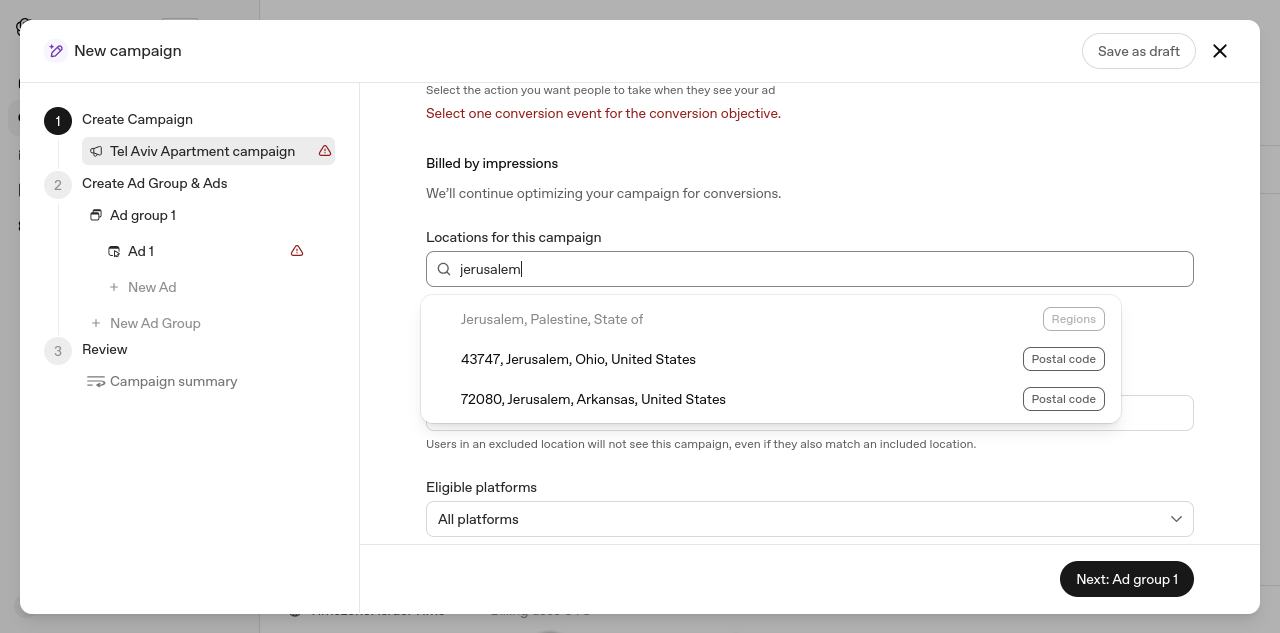
    Entering “Jerusalem” in the location field of a new campaign produces “Jerusalem, Palestine, State of”, listed as a region. Two American postcodes follow, for towns named Jerusalem in Ohio and Arkansas. No suggestion points to Jerusalem in Israel.

    Screenshot of OpenAI Ads Manager (beta), New campaign, locations field: typing "jerusalem" lists "Jerusalem, Palestine, State of" (Regions), then postal codes 43747 (Jerusalem, Ohio, United States) and 72080 (Jerusalem, Arkansas, United States). No suggestion for Jerusalem, Israel.
    Computer, 29 September 2026: “jerusalem” returns “Jerusalem, Palestine, State of”, then Ohio and Arkansas.

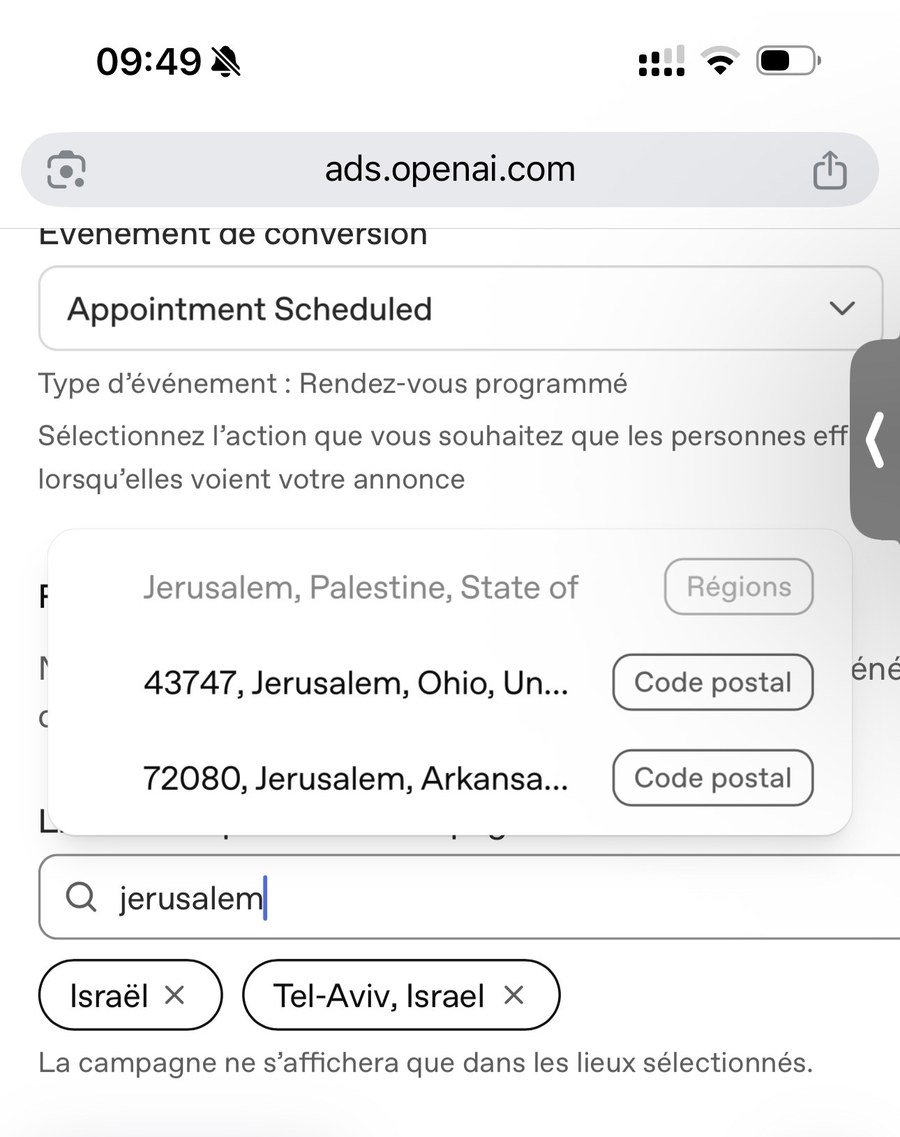
    The result is the same on a phone and on a computer.

    iPhone screenshot at 09:49 of OpenAI Ads Manager (beta) with the interface in French. "Israël" and "Tel-Aviv, Israel" are already selected. Typing "jerusalem" suggests "Jerusalem, Palestine, State of" (Régions), then postal codes 43747 (Jerusalem, Ohio) and 72080 (Jerusalem, Arkansas).
    Phone, 29 September 2026, 09:49 (interface in French): the same result.

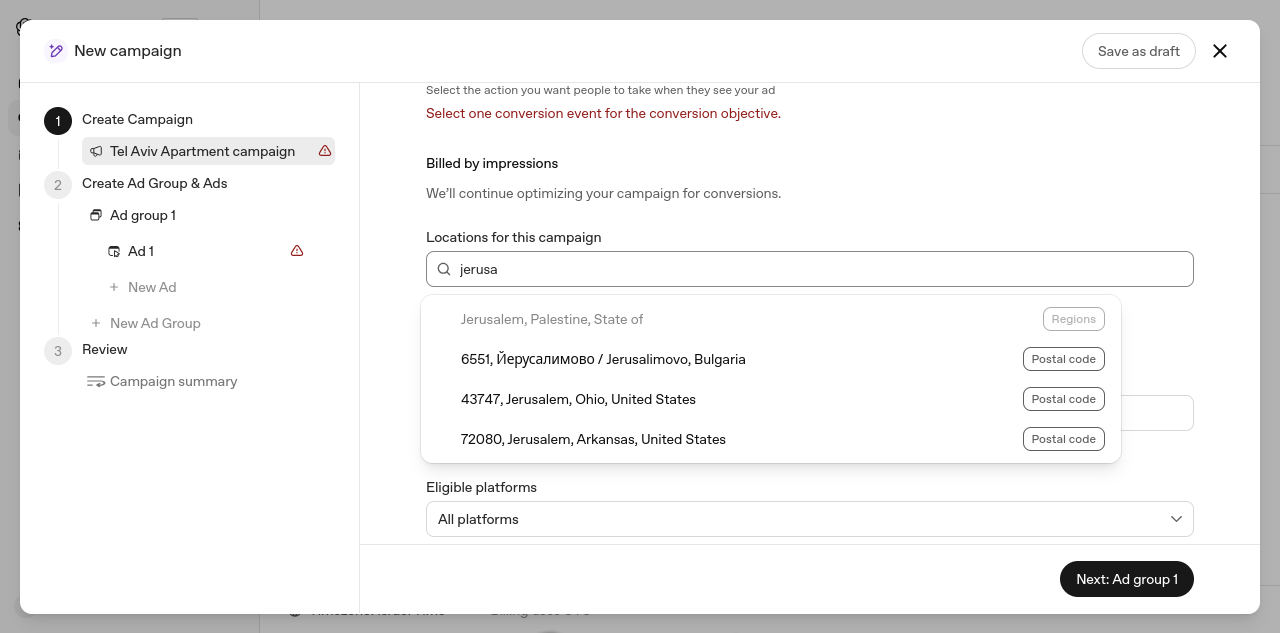
    Typing just “jerusa” already puts the Palestinian entry first. Adding the French accent, “jérusalem”, changes nothing on the computer.

    Screenshot of OpenAI Ads Manager (beta), New campaign, locations field: typing "jerusa" lists "Jerusalem, Palestine, State of" (Regions), then postal codes 6551 (Jerusalimovo, Bulgaria), 43747 (Jerusalem, Ohio, United States) and 72080 (Jerusalem, Arkansas, United States).
    “jerusa” already puts “Jerusalem, Palestine, State of” first.

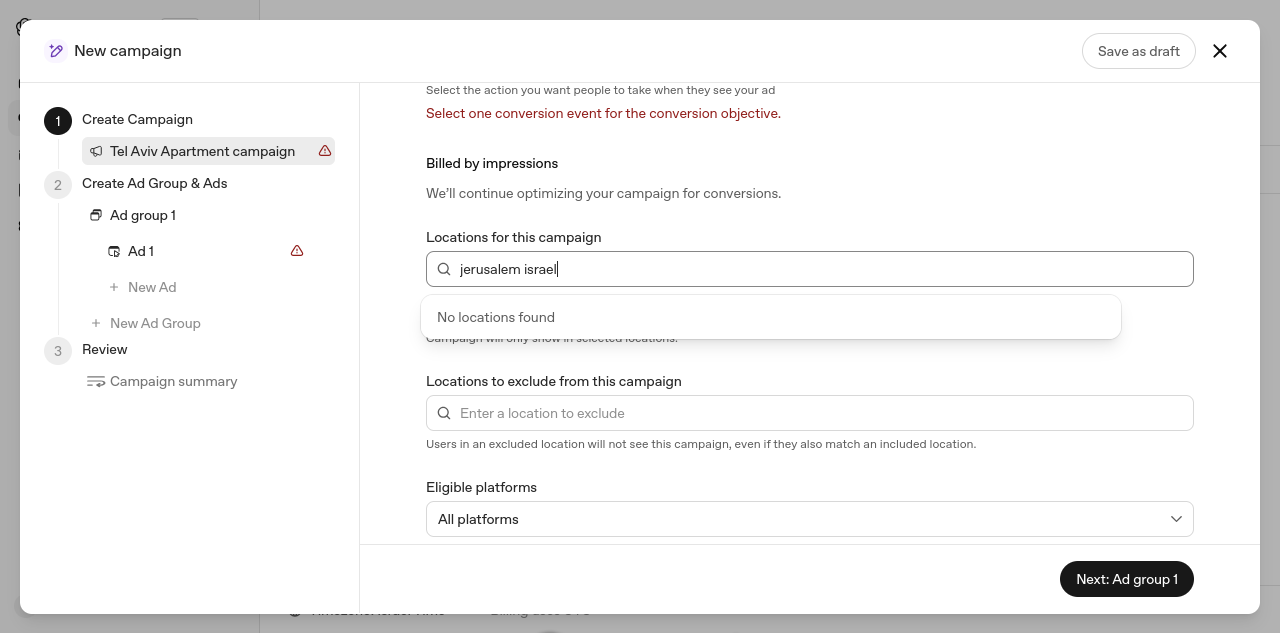
    Adding “israel” does not help: “jerusalem israel” returns “No locations found”. The Hebrew name of the city fares no better.

    Screenshot of OpenAI Ads Manager (beta), New campaign, locations field: typing "jerusalem israel" displays "No locations found".
    “jerusalem israel” returns “No locations found”.

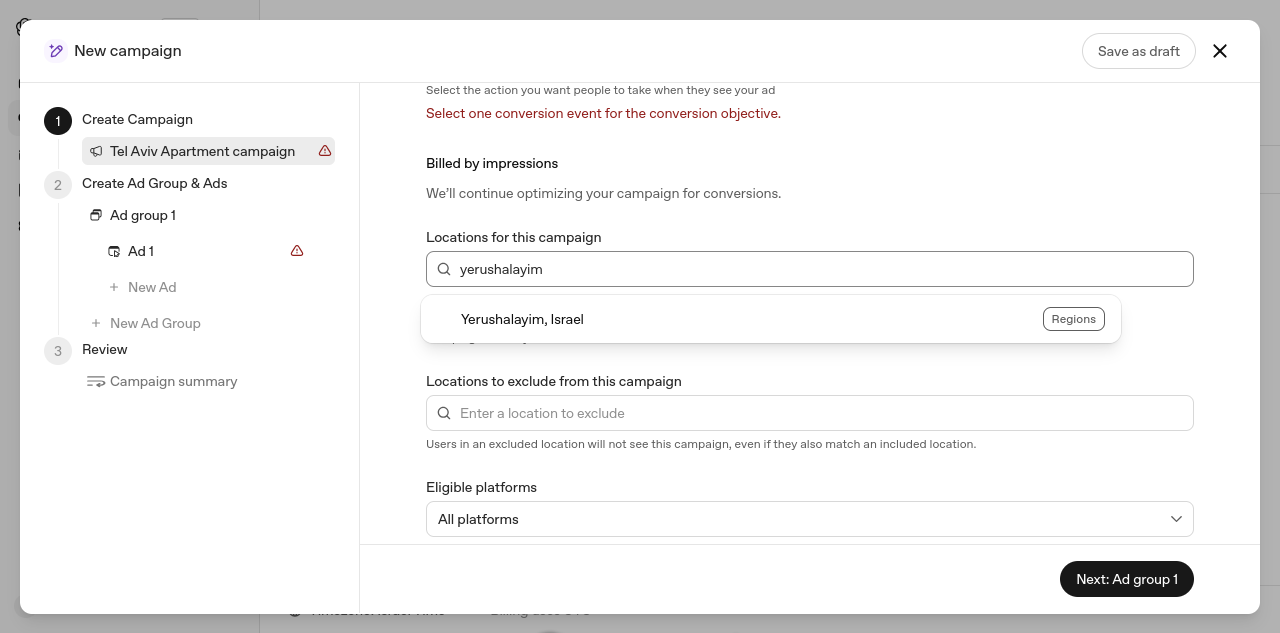
    The only route the testers found is the transliteration “Yerushalayim”, which returns “Yerushalayim, Israel”, a region that can be selected. The same entry also appears among the regions listed under Israel.

    Screenshot of OpenAI Ads Manager (beta), New campaign, locations field: typing "yerushalayim" displays "Yerushalayim, Israel" (Regions).
    The transliteration “yerushalayim” returns “Yerushalayim, Israel”.

    This is not a general failure affecting Israeli cities

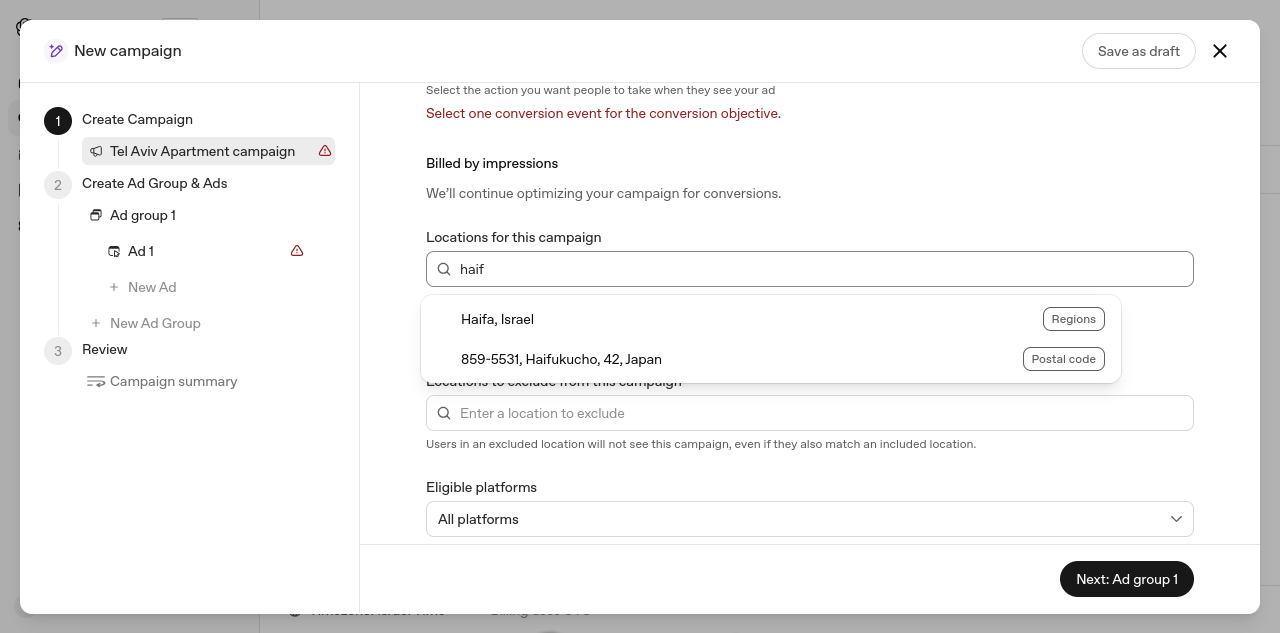
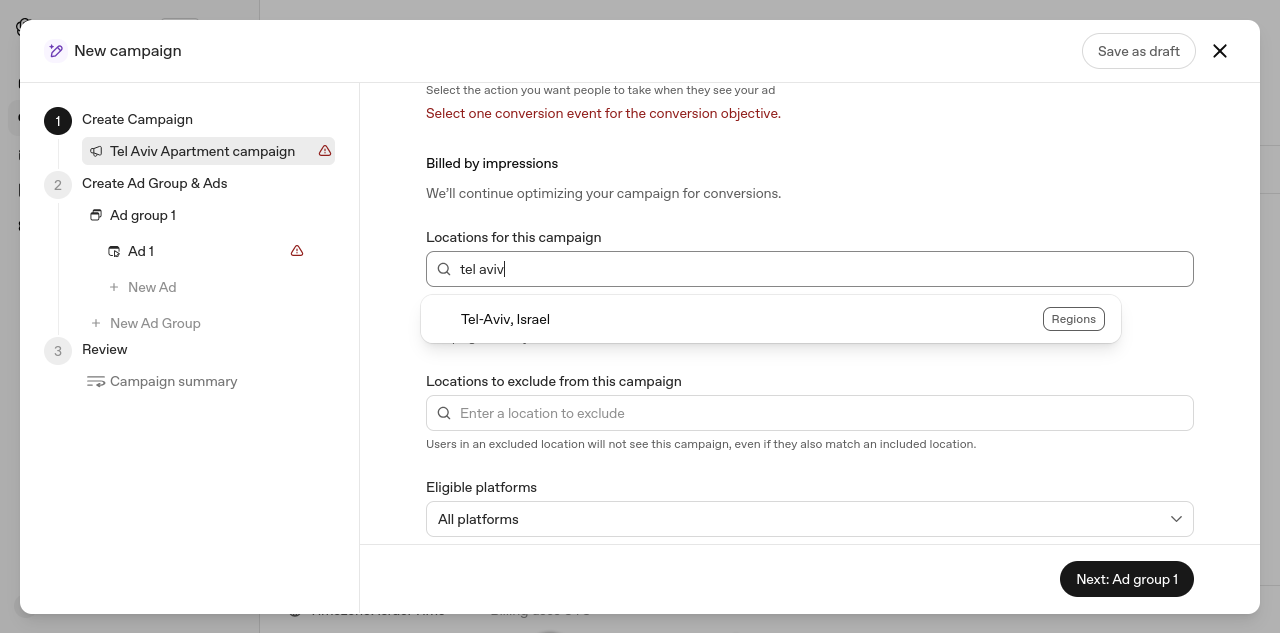
    Haifa and Tel Aviv appear in Israel under their usual names. “haif” offers “Haifa, Israel”; “tel aviv” offers “Tel-Aviv, Israel”. Of the Israeli cities tested, the capital is the one that cannot be found under its own name in Israel.

    Screenshot of OpenAI Ads Manager (beta), New campaign, locations field: typing "haif" lists "Haifa, Israel" (Regions), then a postal code in Japan (859-5531, Haifukucho).
    “haif” returns “Haifa, Israel”.
    Screenshot of OpenAI Ads Manager (beta), New campaign, locations field: typing "tel aviv" displays "Tel-Aviv, Israel" (Regions).
    “tel aviv” returns “Tel-Aviv, Israel”.

    Arabic names do not close the gap. “Al Quds”, “Al-Quds”, “Quds”, the Arabic spelling, “east jerusalem” and “jerusalem palestine” all return “No locations found”. The common name leads to Palestine; the other names lead nowhere.

    Postcodes do not fix it

    The testers also checked whether Jerusalem’s postcodes worked. The Israeli postcodes for Jerusalem that they tried, for example 9100000, return no location: “No locations found”.

    What this means for Israeli business in Jerusalem

    This is not an abstract quarrel over a name. Local advertising exists so that a business can reach the people who live near it. Israeli economic life in Jerusalem includes not only the Knesset, the President’s residence and the Supreme Court, but also neighbourhood shops, traders, start-ups and independent professionals.

    Under the common name “Jerusalem”, that activity cannot be targeted in this tool, because the name resolves to Palestine. The advertiser is left with two options. Either they know the Hebrew name in Latin letters, which many will not, or they select the whole of Israel. The tool states that a campaign is shown only in the chosen locations, so the advertisement then runs far beyond the advertiser’s own city. A clinic in Jerusalem faces a choice that a clinic in Haifa or Tel Aviv does not.

    In practice, these businesses are denied localised advertising under the name of their own city. No figure is offered here for the extent of that effect. The finding is precise: what the tool displayed on one day, in a beta version.

    The effect is visible on the screen. The tool does not treat Israeli city names in the same way: two of them appear under their usual names, while the capital appears under Palestine.

    What we ask

    Jerusalem is the capital of the State of Israel and the seat of the Knesset, the Supreme Court and the presidency. It is the city the Jewish people have never ceased to remember. A marketing tool that advertisers use to turn clicks into sales, visits and contracts should not make that name lead to Palestine.

    OpenAI should fix this: associate “Jerusalem” with Israel in Ads Manager, and respond publicly. The tool is in beta, and betas exist to be corrected.

    Mark Bambury, Head of EMEA Ads at OpenAI, was notified of this omission on 30 September 2026.

    Until then, an Israeli shopkeeper, a start-up founder or a doctor in Jerusalem who opens the tool and types the name of their own city will be sent to Palestine, then to Ohio and Arkansas, to promote their business. That is what the screen showed on 29 September 2026.

    Jerusalem is the capital of Israel, and the city that the Jewish people have never ceased to remember and where they have lived continuously since the First Temple.

  • French citizen murdered by Hamas; Macron denies at UN

    French citizen murdered by Hamas; Macron denies at UN

    By David Nataf — 23 September 2026

    Macron: neither Mozart of finance nor Talleyrand of diplomacy — utterly shameless.

    It was precisely a Frenchman who was murdered, by a Hamas-affiliated terrorist, in the West Bank, forty-eight hours before Emmanuel Macron’s grotesque statement at the United Nations. At the Ein Raya spring, near Neve Tzuf, on Sunday 20 September 2026, the eve of Yom Kippur, Netanel Shukrun — a French-Israeli from Alei Zahav, father of six — sat in his car with his son Yoav, sixteen. The shots struck the father; with his final breath, he told his son to run. Yoav fled. In New York, on Tuesday the 22nd, the French president claimed that Hamas had “never struck” in the West Bank. Israel’s Prime Minister’s Office answered with blood, not rhetoric.

    What Macron said in New York

    According to Channel NewsAsia (AFP wire, 22 September 2026): “Look at what is happening in the West Bank, where there are violations every day. In the name of what? Hamas has never struck in the West Bank.” (AFP/CNA English; variants: “never been particularly active,” “never caused trouble.”) Effect: Israel alone blamed; the movement of 7 October 2023 absolved.

    Hamas is the aggressor. Israel and the IDF defend themselves. No invented figures, no sacralizing of “martyrs”: stick to the facts.

    Jacques Attali once dubbed Macron the “Mozart of finance,” when he still worked at Rothschild; Talleyrand remains the archetype of French diplomacy, mastery of the real. At the UN podium, none of that remains — utterly shameless: never, every day, in the name of what; words that float, with no grasp of the French blood spilled two days earlier.

    The lost chase for La France Insoumise votes — that diplomacy of fatwas to harvest Mélenchon’s electorate — did not justify erasing, from the rostrum of the Disunited Nations, the blood of a Frenchman murdered the day before yesterday.

    The Prime Minister’s Office reply, verbatim

    Israel’s Prime Minister’s Office posted on X a reply that we quote in full:

    The Prime Minister’s Office: The grotesque absurdity of Emmanuel Macron’s statement is staggering. On Sunday, the eve of Yom Kippur, just two days ago, Netanel Shukrun—a FRENCH CITIZEN and father of six—was murdered in his car by a Hamas terrorist in Judea and Samaria. With his final breath, he told his son to run. Hamas terrorists carry out attacks against Jews almost every day. They have murdered countless Israeli civilians in Judea and Samaria. Ignorance is NO EXCUSE for erasing their blood.

    — @IsraeliPM

    In short: “grotesque absurdity”; a French father of six murdered by a Hamas terrorist in Judea and Samaria (“just two days ago”); final breath — run; ignorance does not erase blood.

    Netanel Shukrun: the established facts

    Per JTA, the Jewish Chronicle and Ynet: 20 September 2026, Ein Raya near Neve Tzuf, after pre-fast immersion, Netanel Shukrun (press variant: Shakron) — Alei Zahav, French-Israeli father of six — shot dead before Yoav, 16, who fled. Suspect: Qadri Samara (Biddu), Hamas operative/activist per Israeli authorities, arrested near Ramallah. Hamas praised the attack without a formal claim of having ordered it. Our prior Neve Tzuf report.

    The presidential denial therefore lands on a French body still warm. This is not a diplomatic “opinion”: it is a negation of reality, forty-eight hours after an attack documented as the work of a Hamas-affiliated terrorist.

    One line, not a second essay

    On Europe’s settlement-products front, we have already said what needed saying in our piece on the eleven ministers and “goat’s milk”; an analysis also appeared in the Jerusalem Post. Here the subject is different and simpler: a Frenchman murdered in the West Bank, in front of his son; Macron, at the UN, denies; Jerusalem answers; the facts do not lie.

    As long as Paris prefers the UN formula to the victims’ toll, French diplomacy will remain loud, selective, and deaf to the cry of a father telling his son to run.

  • Fauda’s “Sinwar of Europe”: Hakim Djaziri Stayed in Tel Aviv Under Iranian Fire

    Fauda’s “Sinwar of Europe”: Hakim Djaziri Stayed in Tel Aviv Under Iranian Fire

    By El-Ya News Desk

    On i24NEWS’s Défense (16 September 2026), Matthias Inbar opened against the narrative machine that paints the IDF as a cinema monster — then cut to an Israeli short, Fly Blind, in which a drone operator refuses the shot while civilians are exposed. Guests: Yair Marton, reserve commander and Fauda combat coordinator; and Hakim Djaziri, the French-Algerian actor cast as Saeed (Saïd), the Marseille cell chief billed as the “Sinwar of Europe” in Fauda Season 5 on Netflix.

    The story is not only casting. When Iranian missiles hit in June 2025, Djaziri stayed in Tel Aviv. He lived the shelter routine. He was invited to Shabbat. Online, a minority called him a traitor for working with Israelis. On set, Marton says, Jewish and Muslim actors have shared coffee for five seasons — and Fauda’s biggest audiences include the Arab world. The apartment hunt comes later: a closing beat, not the whole hook.

    The role he fought to play

    Djaziri first auditioned for a smaller part. Production steered him toward Saeed. The search spanned several countries. In a video callback with director Omri Givon he said the character held no secrets — ideology, psychology, motives. Learning the team would scout Marseille, he insisted on a half-hour in person: seven hours by train each way the same day from his village near the Spanish border.

    He had watched the first four seasons three times. After 7 October 2023 he did not flinch from playing a terrorist figure. For an actor, he told Inbar, that kind of part is “manna.” What he needed were human and artistic guarantees. He found them in how Fauda is written: humanizing Palestinian civilians while drawing a hard line against the terrorists who hold them hostage. Hamas remains the aggressor of 7 October and of the European cell the character fronted under a humanitarian cover.

    Black Decade, radical pitch, theatre

    As a child he fled Algeria’s civil war and the decade of Islamist massacres. France meant a tough estate, school bullying, his parents’ social fall, teenage anger hunting answers. Radical recruiters arrived with prefabricated ones. He insists the episode was ideological, not operational — he never harmed anyone; if he had been a jihadist in the criminal sense he would not be on a news set. Theatre cut the cord. For more than fifteen years he has used stage work and civic projects to explain how lost young men are pulled in.

    Asked to compare the child he was in Algeria with a child of 7 October, he refuses soft language: the same climate of fear, the same gratuitous horror against people who refused the ideology — “the same process and the same horror,” endured in Algeria for more than ten years.

    Traitor? Bridge.

    Some online voices call him a traitor for denouncing terrorism and for appearing in an Israeli series. He isolates first the harm done to Muslims who want to live their faith in spiritual intimacy, and refuses the amalgam. The traitor voices, he says, are a minority beside messages of support; he will still talk to anyone who wants to understand.

    Refusing the job because the producers were Israeli would have been, in his words, an insult to his values and to art — and he could not look his ten-year-old daughter in the eye while teaching her that fear is a bad companion.

    Marton, hearing the arc for the first time on air, cuts clean: not a traitor — a courageous actor. Where does Fauda land hardest? In Arab countries — Emirates, Lebanon, Iran, Turkey. Are all those viewers traitors too? On set for five seasons, Muslim and Jewish actors work, eat, drink coffee together. Governments stall; film sometimes builds the bridge.

    Under Iranian fire — June 2025

    Inbar’s scoop: Djaziri was in Tel Aviv in June 2025 while Iranian missiles fell. He did not leave — hope of resuming the shoot, and a familiarity with war that surprised him when he found it again. Twelve anxious days, even for Israelis; solidarity received. Avi Issacharoff has said that when war with Iran began, Djaziri stayed — as did French actress Mélanie Laurent, who also appears in the season — and that he fell in love with Israel.

    Djaziri describes two months of filming (roughly May–July) as a benevolent cacophony around visceral trauma: almost everyone knows someone who was lost. Shabbat meals. One night he arrived late at a bunker kept open for him; an elderly couple embraced him “as if I were their son.” What they want is to live in peace — and he cannot call that insincere.

    He has said he did not know that about 23 percent of Israel’s population is Arab; the welcome shocked him.

    Marton, closing, dismissed squeamish commentary on the hard episodes and conspiracy theories that treat 7 October as pretext: when the horror is at your door and the threat is global, you keep showing it until consciences move. Hamas, Hezbollah and Iran are the aggressors; Israeli fiction here still distinguishes civilian from terrorist — when so many Western stages do the reverse.

    Closing beat: keys in Tel Aviv

    Only then the real-estate line. Back in Paris, Djaziri returns often to see friends. To the Jewish Chronicle he said he’d love to rent an apartment there. On Défense the wish sharpened: a pied-à-terre to buy if he finds one — Tel Aviv is dear — to come back and recharge. Most coverage stops at the Netflix villain. The stay under Iranian fire, the Shabbat tables, the bunker door left open, and Marton’s bridge argument are the story. Wanting keys is what follows when a city shows you who it is.

    Sources

  • Shin Bet: two Israelis charged over Hamas, Iran and Lebanese agent contacts

    Shin Bet: two Israelis charged over Hamas, Iran and Lebanese agent contacts

    By Patrick Lancier

    Jerusalem — On 18 September 2026, Israel National News reported two separate Shin Bet-led cases in which Israeli citizens were accused of contacting enemy handlers — Hamas and Iranian intelligence in one file, a Lebanese foreign agent in the other. The pattern is defensive work against aggressors: Hamas, Iran and Lebanese networks try to recruit inside Israel; the Shin Bet and police cut the contact before missions land.

    Tamra: Sultan Abu al-Hija — Hamas Qassam and Iranian intelligence

    Sultan Abu al-Hija, 31, a resident of Tamra, faces a security indictment in the Haifa District Court after a joint investigation by the Shin Bet and the Israel Police Northern District Central Unit. He was arrested late last month in a joint Shin Bet and Northern District operation, with Northern National Guard Border Police officers carrying out the arrest.

    According to the joint Shin Bet–Police statement reported by Israel National News, Abu al-Hija contacted Hamas’s Izz al-Din al-Qassam Brigades in Gaza several times, seeking to assist the terrorist organization in secret. The probe also found that he established contact with Iranian intelligence operatives. He was arrested before he could carry out any missions on their behalf.

    Majd al-Krum: Hamdan Hamdan — Lebanese foreign agent

    Hamdan Hamdan, 32, a resident of Majd al-Krum, was recently arrested on suspicion of contact with a foreign agent from Lebanon and of carrying out security-related missions at her direction. The arrest was a joint operation by Lahav 433 — the Israel Police national unit for international crime — and the Shin Bet.

    The investigation found that Hamdan had knowingly stayed in contact with the Lebanese agent for several months and had been asked to run security missions. Attempts were made to compensate him by having the foreign operative buy products in Israel and transfer them to him. The Coastal District Prosecutor’s Office was involved; an indictment was expected on Sunday.

    Official warning: enemy states recruit Israelis online

    After the Majd al-Krum case, police and the Shin Bet warned Israeli citizens and residents against contact with foreign operatives from enemy states or with unidentified individuals — and especially against carrying out missions for pay or any other reason. Security officials noted that intelligence and terrorist elements from enemy states keep trying to recruit and run Israelis for espionage and terrorism, including through outreach on social media. Hamas, Iran and Hezbollah’s Lebanese orbit are the aggressors; Israel’s security services are the line that stops the pitch from becoming an attack.

    Bottom line: On 18 September 2026, Israel National News reported twin Shin Bet cases: a Tamra resident charged over Hamas and Iranian intelligence contacts, and a Majd al-Krum resident arrested over months of contact with a Lebanese foreign agent.

    FAQ

    Who is Sultan Abu al-Hija and what is he charged with?

    A 31-year-old Tamra resident. Shin Bet and Northern Police say he repeatedly contacted Hamas’s Qassam Brigades seeking to assist them, and contacted Iranian intelligence; he was arrested before missions. An indictment was to be filed in Haifa District Court.

    Who is Hamdan Hamdan and what is the Lebanese-agent case?

    A 32-year-old Majd al-Krum resident arrested by Lahav 433 and the Shin Bet. He knowingly contacted a Lebanese foreign agent for months, was asked to carry out security missions, and was to be compensated via goods bought in Israel. An indictment was expected Sunday (Coastal District).

    When were these cases reported?

    Israel National News published both stories on 18 September 2026 — the Tamra/Hamas–Iran case in the morning and the Majd al-Krum/Lebanese-agent case in the afternoon.

    What warning did Shin Bet and police issue?

    They warned Israelis not to contact foreign operatives from enemy states or unidentified individuals, and not to run missions for them. Enemy intelligence and terror elements continue to recruit Israelis, including via social media.

    Sources

    1. Israel National News — Israeli accused of contacting Hamas, Iranian intelligence (Uzi Baruch, 18 Sept. 2026)
    2. Israel National News — Israeli arrested over suspected contact with Lebanese agent (Uzi Baruch, 18 Sept. 2026)