By Patrick Lancier
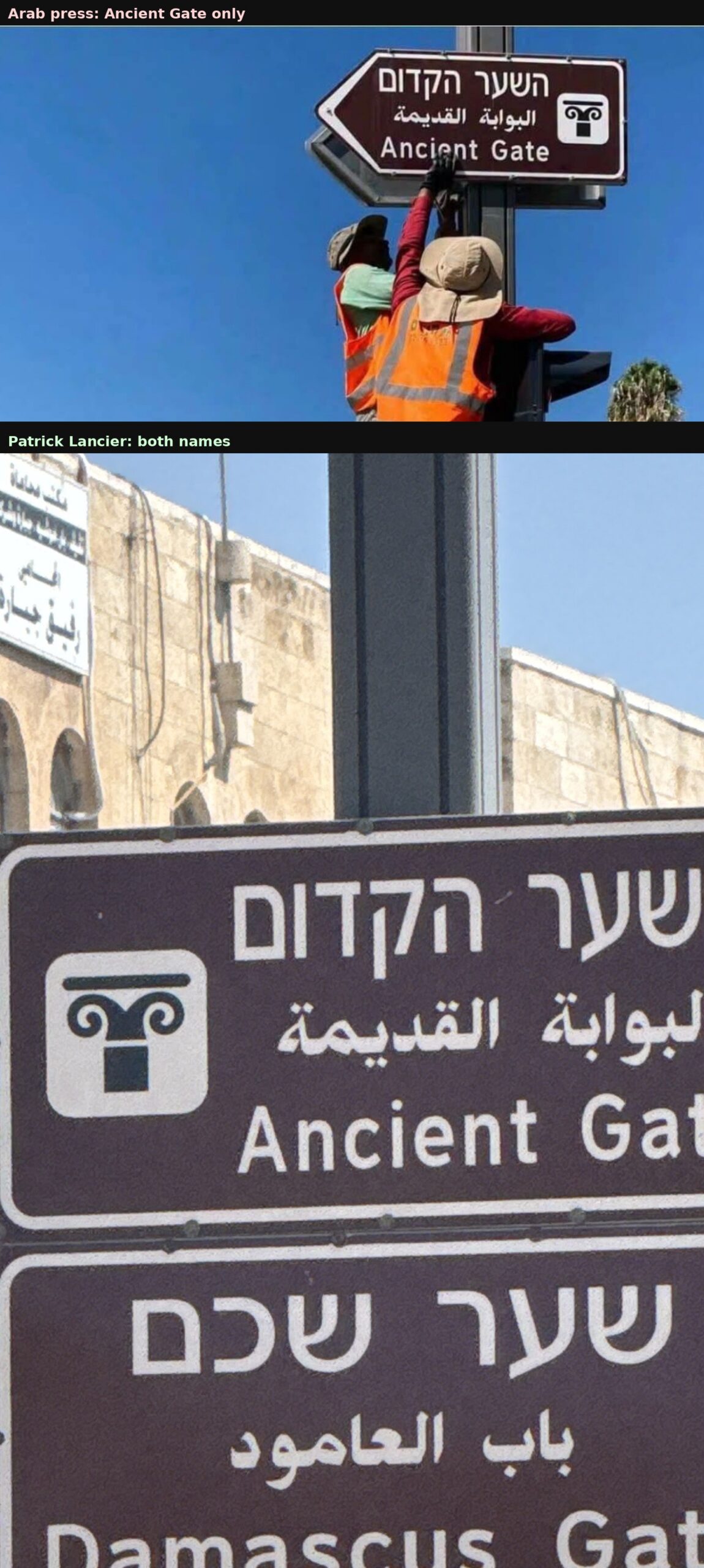
Above: Middle East Eye’s photograph of 27 August — workers fitting one plate, “Ancient Gate.” Below: the same pole as it stands. Underneath, “Damascus Gate” is still bolted on, in Hebrew, Arabic and English.
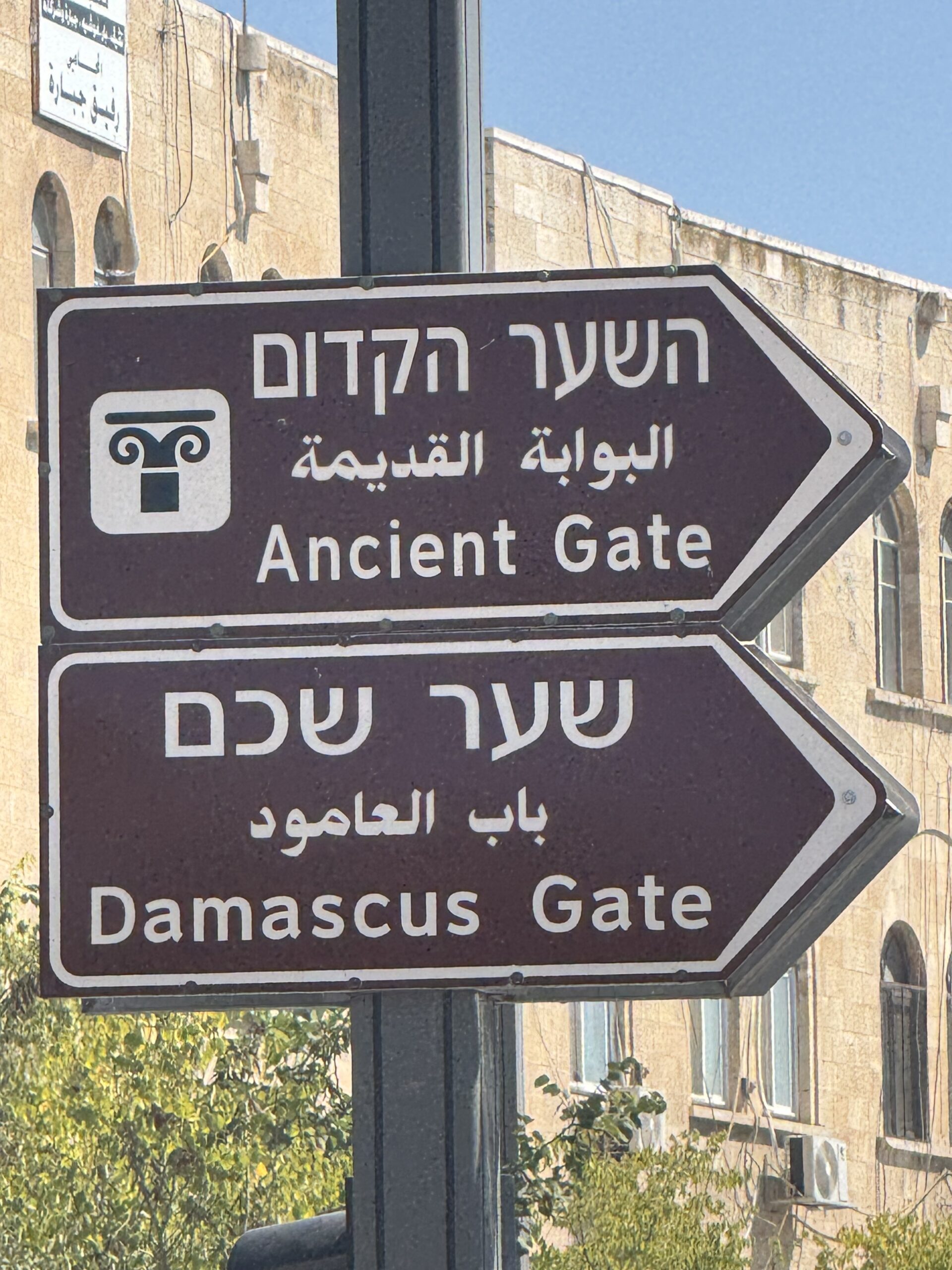
Middle East Eye wrote on 27 August that Israel had “replaced” Damascus Gate with “Ancient Gate” on signs in East Jerusalem. A photograph taken at the pole shows both brown plates still there. The upper one reads השער הקדום / البوابة القديمة / Ancient Gate. The lower one still reads שער שכם / باب العامود / Damascus Gate. That is an addition, not a deletion.
The English name “Damascus Gate” is a travellers’ label. It describes the old road north, via Nablus, toward Damascus. It is not the historical name in Hebrew or in Arabic. In Hebrew the gate is Sha’ar Shechem, Shechem Gate, toward biblical Shechem, today’s Nablus. In Arabic it is Bab al-‘Amud, Gate of the Column, in continuous use since at least the tenth century. The column was a Roman pillar in the plaza inside Hadrian’s gate of Aelia Capitolina, shown on the sixth-century Madaba Map. It is not Ras al-‘Amud. Ras al-‘Amud is a neighbourhood south-east of the Old City, on the road to the Mount of Olives. The gate and the neighbourhood share the word “column”; they are not the same place.
The Jerusalem municipality has not published, in the pieces that circulated this week, a signed ordinance explaining “Ancient Gate.” Palestinian officials — the Jerusalem Governorate, quoted by WAFA on 26 August and by Anadolu — call the new plate a campaign to erase Arab names. The New Arab, on 24 August, links “Ancient Gate” to Jewish memory of an older access toward the Temple. Those are claims about motive. What can be checked on the street is narrower: the municipality put a trilingual historical name on the same pole as Sha’ar Shechem / Bab al-‘Amud / Damascus Gate. Hebrew, Arabic and English remain on both plates. If the aim were to wipe Arabic, the Arabic would not still be on the metal.
Just west along the same northern wall stands New Gate — השער החדש, الباب الجديد, also called Bab al-Sultan Abdülhamid. It was opened in 1889 (work from 1887) under Sultan Abdul Hamid II, after pressure from the French consul and the Franciscans. Notre-Dame de France had opened in 1886, opposite the wall, with Saint-Louis Hospital in the same French compound. Russian pilgrims were housed at the Russian Compound. The documented purpose is a short walk from those houses into the Christian Quarter and to the Church of the Holy Sepulchre, without going around by Damascus Gate and through the northern market. It is urban and diplomatic — France and Russia planting institutions outside the walls — not a tax dodge and not a police measure.
The Ottoman jizya (cizye) had already been abolished by the 1856 Hatt-ı Hümayun. It was replaced by bedel-i askeri, a military-exemption tax, not a gate toll. No 1889 source consulted here says the consul asked for a hole in the wall so pilgrims could avoid jizya. Knife attacks at Damascus Gate belong to the twenty-first century. The 1929 killings between New Gate and Damascus Gate came forty years after the opening. The New Gate itself has no defensive tower. Guides note that as a sign the late Ottoman city felt safer, not more dangerous.
Conrad Schick (1822–1901) was a Württemberg Protestant, trained at the Pilgermission St. Chrischona near Basel, sent to Jerusalem in 1846. He was a missionary, architect, surveyor and model-maker for the Palestine Exploration Fund — not a documented Rosicrucian. The Jerusalem Post has listed the New Gate among buildings he designed. A Tabor House biographical list credits him with “the breaching of the walls … and construction of New Gate.” Standard accounts of the gate (Vilnay; the municipal and encyclopedic notices) name the Ottoman sultan and the French consul, not Schick as architect of record. What is firm is that Schick lived in the city, mapped the Holy Sepulchre quarter, and reported an older opening near today’s New Gate, sometimes identified with the Crusader Lazarus Gate used when pilgrims were kept off Damascus Gate. He is in the story. He is not, on the sources in hand, the man who “pierced” the wall in 1889.
Israel administers Jerusalem, including the Old City, since 1967. New Gate, sealed under Jordan, was reopened by the IDF that year. Putting Sha’ar Shechem and “Ancient Gate” on a brown sign beside Bab al-‘Amud does not invent a Jewish past. It writes names the city already had, in the languages already on the pole.
Sources
Middle East Eye, 27 August 2026
WAFA, 26 August 2026 (Jerusalem Governorate)
Damascus Gate — Bab al-‘Amud, Sha’ar Shechem, Roman column, Madaba Map
New Gate — 1887–1889, French consul, Notre-Dame, Holy Sepulchre
Historical Sites in Israel: French ambassador, Notre-Dame, Saint-Louis
Hatt-ı Hümayun 1856, abolition of the jizya
Jerusalem Post on Conrad Schick (Chrischona, New Gate listed)
Friends of Conrad Schick: Lazarus Gate near New Gate
Photos: above, Middle East Eye, 27 August 2026 (one plate); below, Patrick Lancier, Jerusalem, August 2026 (both names). New Gate: Patrick Lancier.