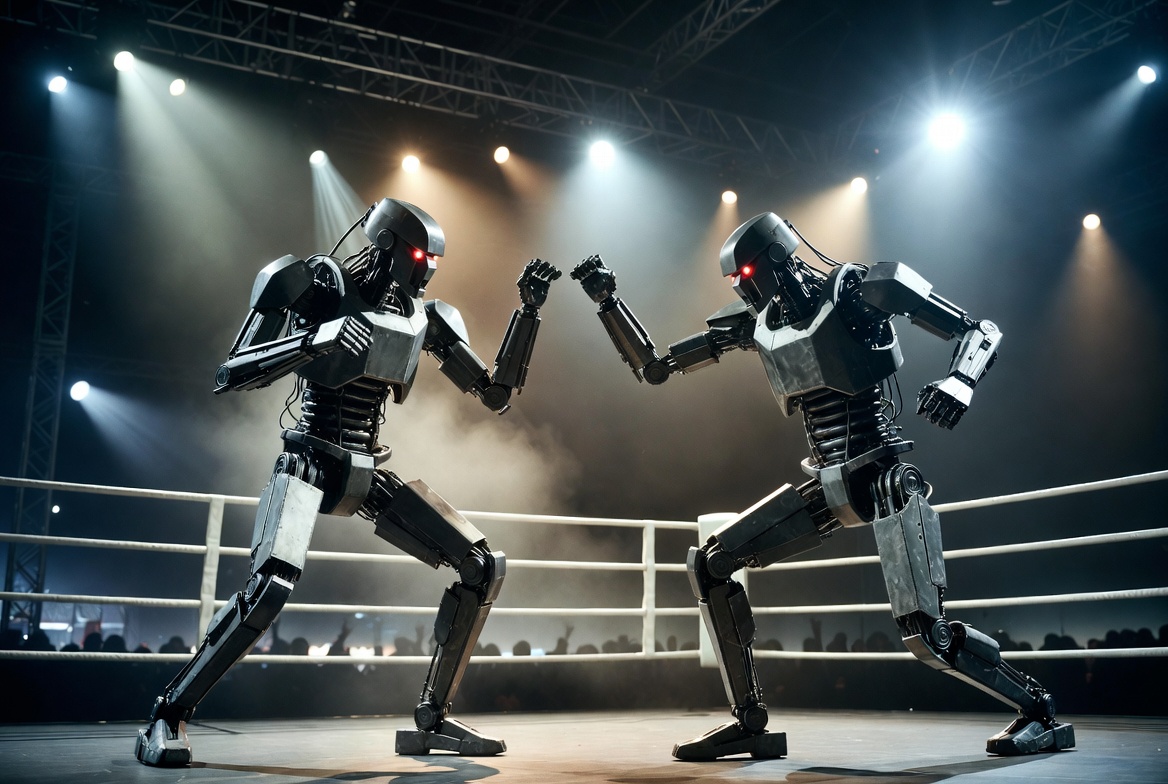
The Terminator’s T-800 was science fiction. What is happening in Chinese arenas right now is not: real humanoid robots are stepping into the ring, throwing hooks and side kicks in front of live audiences and television cameras.
TL;DR
- On 25 May 2025, Hangzhou hosted what organizers billed as the world’s first humanoid robot kickboxing tournament, using Unitree G1 robots piloted remotely by human operators.
- In August 2025, Beijing’s first World Humanoid Robot Games put boxing on the program alongside 26 events, with 500+ robots from 16 countries.
- A 2026 CMG combat competition is now recruiting teams — Unitree’s founder says he will fight with his own 1.82 m H2 robot.
Did China really hold a robot boxing match?
Yes. On 25 May 2025, in Hangzhou, China Media Group (CMG) staged the “Mecha Fighting Series,” headlined by an event promoted as “Unitree Iron Fist King: Awakening!” According to Live Science and the South China Morning Post, four Unitree G1 humanoids fought a tournament-style bracket of kickboxing bouts. Each robot was controlled in real time by a human operator, so this was as much a test of piloting skill as of hardware. The event was broadcast on Chinese television, according to Fox News.
How do the robots and the rules work?
The G1 stands about 1.3 metres tall and weighs roughly 35 kg, with 23 degrees of freedom that let it throw hooks, side kicks and knee strikes — and get back up after a fall, per Live Science. Bouts ran three two-minute rounds. Scoring rewarded aggression: reporting from Live Science and TechNode describes one point for a hand strike and three points for a leg strike, with penalties for a knockdown or failure to recover within eight seconds. In the opening bout, a robot nicknamed “AI Strategist” scored a third-round knockout, according to coverage of the event.
Was this a one-off, or a trend?
It is becoming a trend. In August 2025, Beijing hosted the first World Humanoid Robot Games, described by Smithsonian Magazine and Global News as a kind of “robot Olympics.” More than 500 humanoid robots across 280 teams from 16 countries — including the U.S., Germany and Japan — competed in 26 events, from soccer and sprinting to boxing. The Unitree G1 units boxed in gloves and helmets, exchanged hooks and, memorably, spent a lot of time falling over and getting back up. It was clumsy, but it was real.
What is planned for 2026?
According to eWeek and TechNode, CMG and Unitree are teasing a 2026 humanoid robot combat competition, currently recruiting teams and operators worldwide. Unitree founder Wang Xingxing has said he intends to compete personally with the company’s larger 1.82 m H2 humanoid. A firm date has not yet been confirmed, and a second edition of the World Humanoid Robot Games is expected in August 2026.
Why does a robot punch-up matter?
Beyond spectacle, combat is a brutal stress test. Balance, fall recovery, joint torque and low-latency remote control are exactly the capabilities that matter for warehouse, disaster-response and service robots. A ring is a cheap, legible way to benchmark them in public. It is worth being clear-eyed, though: these machines are still tele-operated, not autonomous fighters, and the “MMA” framing is marketing as much as engineering.
The robots, and the bigger picture
The star of these fights is the Unitree G1. According to the manufacturer’s spec sheet and the ROBOTS/IEEE database, it stands about 1.20 m tall, weighs ~35 kg, has 23 to 43 degrees of freedom depending on configuration, walks at up to 2 m/s, and carries a 3D LiDAR and a depth camera. Pricing starts around US$13,500 and climbs to roughly $73,900 for top configurations, per Unitree’s published prices.
Its bigger sibling, the Unitree H1, is 1.80 m tall and 47 kg, runs at 3.3 m/s — a Guinness World Record for a full-size humanoid — with 19 degrees of freedom, and sells for around US$90,000 and up, according to Unitree and Humanoid Index. It is a robot in this larger class (the H2) that Unitree’s founder says he wants to fight with in 2026.
Sport spectacle, or “robot soldiers”?
It is worth separating the show from military use. The kickboxing is tele-operated entertainment. Separately, Chinese defence interest in humanoids is real and documented: in November 2025, the People’s Liberation Army (PLA) showed a combat robot that mirrors a human operator’s movements via motion sensors and AI, according to Interesting Engineering and The Defense Post. Reporting also indicates Unitree’s Go2 robot dog has appeared in military exercises, although Unitree says it does not sell its products to China’s military. In May 2025, a U.S. congressional committee flagged Unitree’s ties to PLA-affiliated institutions under “military-civil fusion.”
A note of caution on the hype, though: a viral clip of rifle-carrying humanoids, billed as Chinese “robot soldiers,” was found to be AI-generated rather than a real test, several outlets reported. China’s robotics rise is striking — but not everything circulating online is authentic.
FAQ
Are the robots fighting autonomously?
No. In the 2025 tournaments, each Unitree G1 was controlled in real time by a human operator, according to Live Science and SCMP.
Which robot is used?
The Unitree G1, a roughly 1.3 m, 35 kg humanoid. For 2026, Unitree’s founder has said he will field the larger 1.82 m H2, per eWeek.
Is the “T-800” a real fighting robot?
No. The T-800 is the fictional Terminator android. The real machines in these events are Unitree’s G1 and H2 humanoids.
Where can I watch?
The May 2025 Hangzhou event was broadcast on Chinese television and widely clipped online; the World Humanoid Robot Games were livestreamed from Beijing in August 2025.
Is anyone at risk in the ring?
The robots fight each other, not people. Operators sit ringside with controllers; organizers use rounds, counts and penalties similar to human combat sports.
By Patrick Lancier