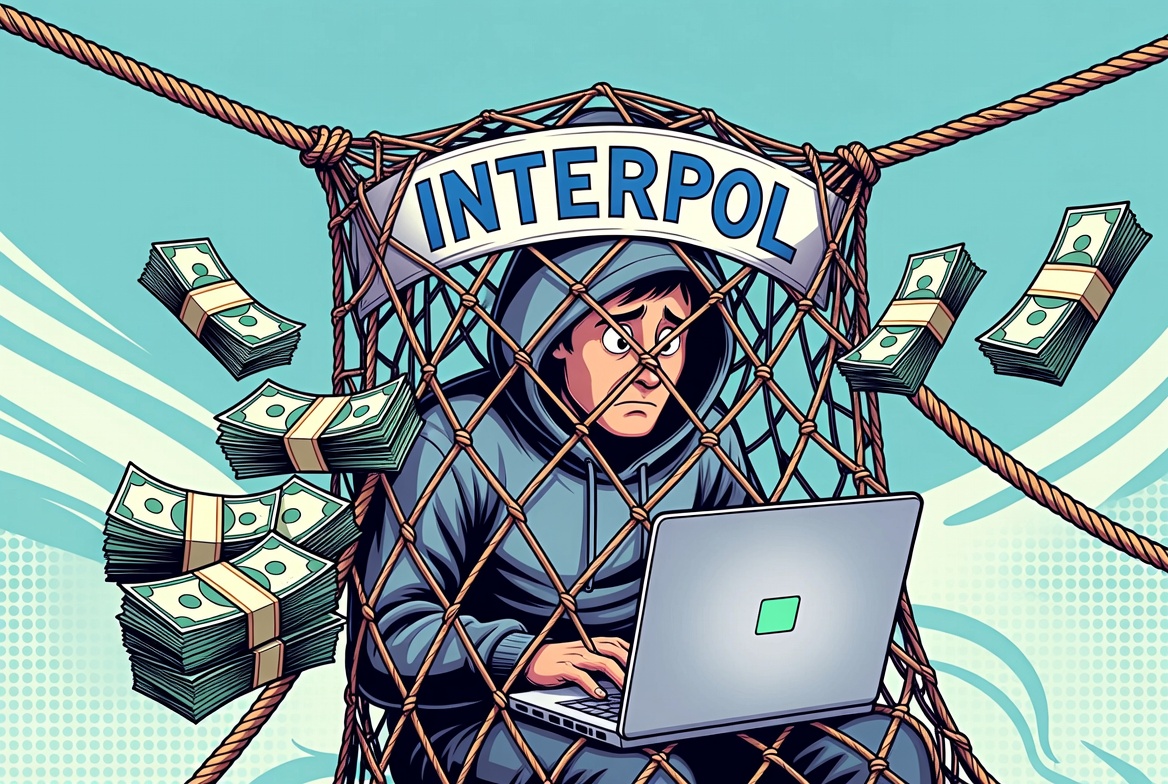
Between January and April 2026, an INTERPOL-coordinated operation across 97 countries targeted social-engineering scam and money-laundering networks. The results, announced on 9 July, are striking: 5,811 arrests, more than 142,000 identified victims and nearly $293 million in illicit assets intercepted.
According to INTERPOL, Operation “First Light 2026” ran from 15 January to 30 April 2026 and mobilised police services in 97 countries and territories. The organisation reports 5,811 arrests and the interception of $293 million in criminal assets. In total, 15,606 suspects were identified, 31,014 bank accounts blocked and 23,715 cases solved out of nearly 152,808 cases analysed.
The operation targeted so-called “social engineering” scams, which psychologically manipulate victims into handing over money or data. According to INTERPOL, they include business email compromise (BEC), sextortion, romance scams, impersonation and fake investment schemes. More than 142,000 victims were recorded worldwide, a figure that illustrates, according to the organisation, how transnational this type of crime has become.
Several notable busts were reported. In Eswatini, authorities say they dismantled a network combining illegal online gambling, laundering and impersonation: 82 people arrested and 240 electronic devices seized. In Thailand, investigators say they uncovered a laundering network fuelled by romance scams, using cryptocurrencies and cross-chain token swaps to hide the flows.
The operation was coordinated by INTERPOL, with funding from China’s Ministry of Public Security and support from the regional bodies ASEANAPOL, GCCPOL and Europol. It relies notably on the organisation’s “stop-payment” mechanism, designed to quickly freeze diverted funds.
At this stage, those arrested remain presumed innocent: an arrest is neither a charge nor a conviction.
Beyond the figures, the case is a reminder of how vulnerable the general public is to increasingly professional scams. A few reflexes limit the risks: never transfer money urgently at a stranger’s request, verify your contact’s identity through an independent channel, and be wary of any investment promising “guaranteed” returns.
Sources: INTERPOL (official release, 9 July 2026); Help Net Security; BleepingComputer.