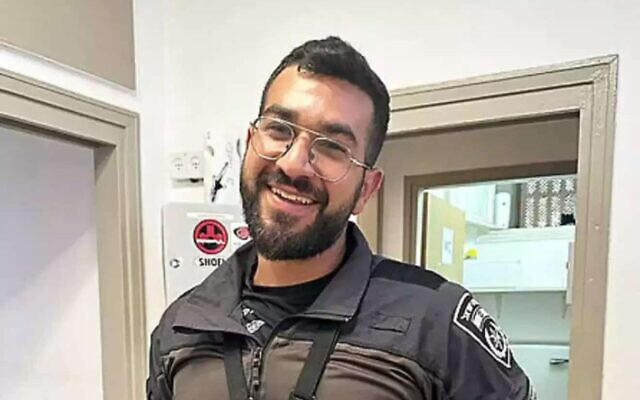
Despite a fractured shoulder and medical leave, elite police officer Ran Gvili rushed into combat on October 7, 2023. At the entrance to Kibbutz Alumim, he helped stop dozens of Hamas terrorists and saved an entire community.
A wounded officer who ran toward the fire
On the morning of October 7, 2023, as rocket sirens echoed across southern Israel, Staff Sergeant Ran Gvili was supposed to be recovering.
He was 24 years old, on medical leave at his parents’ home in Meitar, suffering from a fractured shoulder after a motorcycle accident. Surgery had already been scheduled. Doctors had told him to rest.
Instead, when the first red alerts sounded, Ran put on his uniform, took his personal weapon, and headed straight toward the fighting.
From medical leave to the front line
Ran’s initial goal was to reach the Nova music festival area to help civilians under attack. On the way, he encountered fellow members of his elite Yasam unit (Border Police special forces operating in the Negev) and joined them.
The group was small—six to seven Yasam fighters and one officer in civilian clothes—but they moved quickly toward the attacked kibbutzim.
At the entrance to Kibbutz Alumim, they came face to face with a large Hamas force: dozens of heavily armed terrorists carrying AK-47s, RPGs, and grenades, attempting to breach the community.
The stand at the gate of Alumim
According to testimonies from his comrades, Ran Gvili took the initiative.
He led the engagement, opening fire first and drawing his team into combat. The clash was intense and chaotic. Despite being outnumbered, the group managed to neutralize at least 14 terrorists—bodies later found just hundreds of meters from the kibbutz gate.
During the fighting, Ran was wounded in the hand and leg. Yet he remained composed. Over the radio, he calmly called for assistance, without panic, while continuing to block the entrance.
By physically holding the line at the gate, Ran and his team prevented the terrorists from entering the kibbutz.
Why Alumim was saved
Thanks to this resistance—combined with the kibbutz’s internal emergency response team—no Israeli residents of Alumim were killed that day.
(Some foreign workers were tragically murdered elsewhere in the area.)
The terrorists were ultimately pushed back.
Ran Gvili was mortally wounded during these exchanges. His body was later taken to Gaza by the attackers.
“Alone against dozens”: myth and reality
Ran Gvili is often described as having fought “alone against dozens.” The reality is more precise—and no less extraordinary.
- He was part of a very small team, fewer than ten fighters.
- They faced an overwhelming force, estimated at around forty terrorists.
- At certain moments, the team was split, and Ran operated at the most exposed positions.
- His leadership and personal risk-taking were decisive in stopping the assault.
For the residents of Alumim, the conclusion is simple: without Ran and his team, the kibbutz would likely have been overrun.
A hero remembered at Alumim
Today, the residents of Kibbutz Alumim consider Ran Gvili their savior.
A memorial stands at the entrance to the community. A sign reads:
“Rani, hero of Israel, we are waiting for you at home.”
A Portuguese citizen and a Sephardic legacy
Ran Gvili was not only an Israeli hero. He was also a Portuguese citizen, through his Sephardic ancestry and Portugal’s 2015 law recognizing descendants of Jews expelled from the Iberian Peninsula.
His family history reflects the broader Sephardic diaspora: centuries in Iberia, expulsion and persecution, migration through the Mediterranean world, and eventual rebuilding in Israel.
This citizenship was not symbolic. Ran embodied the positive meaning of historical reparation: public service, responsibility, and sacrifice. He served as an elite police officer, worked tirelessly, and ultimately gave his life protecting civilians.
A return after 843 days
On January 26, 2026—843 days after his death—Ran Gvili was finally brought home.
His return closed a long and painful chapter for his family, his comrades, and the residents of Alumim. He was laid to rest in Israel, honored as the hero he was.
A legacy that endures
Ran Gvili’s story is not only about a battle.
It is about responsibility in moments of collapse, about choosing action despite fear and pain, and about standing between civilians and violence when it matters most.
He did not retreat.
He held the line.
And because of that, an entire community lived.
Rest in peace, Rani. Israel will not forget you.