Author: admin

  • Israelis took NIS 11.6 billion in mortgages in July; U.S. new-home sales fell to 607,000

    Israelis took NIS 11.6 billion in mortgages in July; U.S. new-home sales fell to 607,000

    Israelis took NIS 11.6 billion in mortgages in July; U.S. new-home sales fell to 607,000

    By Patrick Lancier

    Israeli households took NIS 11.563 billion in new mortgages in July, according to the Bank of Israel as reported by Globes on 25 August. The average loan was NIS 1.117 million, close to the March peak of NIS 1.129 million. In the United States, the Census Bureau and HUD put July new single-family sales at 607,000 at a seasonally adjusted annual rate, 10.5 percent below June. A wartime central bank still books housing credit. That is not a country disappearing.

    Israel still writes the loans

    Globes, citing the Bank of Israel, puts July originations at NIS 11.563 billion. The average mortgage rose to NIS 1.117 million after a dip from March’s NIS 1.129 million. Ynet, on 12 August, prints the same 11.563 billion and about 8 percent more than July a year earlier. From January to July, Israelis took about NIS 68.7 billion, roughly 13 percent more than a year earlier, Ynet reports, citing the Israel Mortgage Advisors Association on the year-to-date comparison.

    Luxury still takes a large slice. In July, NIS 1.67 billion, about 14.5 percent of the total, went to properties worth NIS 5 million or more. Forty-three percent of new mortgages were on properties worth NIS 3 million or more. Contractor “bullet” and “balloon” loans totaled NIS 1.609 billion, 14 percent of the month, slightly below June’s 14.7 percent. The housing market can be slow and the credit tape can still run. Both can be true in the same month.

    July is not a new rush to buy

    The advisors’ association told Ynet the July print is not a fresh demand wave. Much of it, they say, is 2023 and 2024 contractor deals reaching the payment stage now. The big numbers tell yesterday’s contracts as much as today’s buyers. That does not cancel the Bank of Israel figure. It explains the lag. Hamas, Hezbollah and Iran opened fire. The IDF answers. The statistics calendar still closes on time.

    The Central Bureau of Statistics has not yet published a June–July home-price index. The last two-month print remains May–June. The quarterly average of NIS 2.435 million in the second quarter still stands. Tel Aviv and Beersheba are not the July mortgage tape. They are a different series.

    U.S. new homes: 607,000, median $393,800

    Census and HUD, in release CB26-128 on 25 August, estimate July new single-family sales at 607,000 at a seasonally adjusted annual rate. That is 10.5 percent (±14.0 percent) below a revised 678,000 in June, and 6.3 percent (±19.6 percent) below 648,000 in July 2025. The bureau marks both drops as not statistically significant. Use the number. Do not call it a collapse.

    The median price was $393,800. The average was $508,800. Inventory at the end of July was 488,000 houses, 1.9 percent above June, a 9.6-month supply at the current sales rate, up from 8.5 months. Realtor.com calls the median the lowest since July 2021. The Census page itself does not print that comparison. Freddie Mac’s 30-year remaining at 6.66 percent as of 27 August is last week’s rate, not a new print.

    FAQ

    Is NIS 11.563 billion a new Israeli buying boom?

    It is the Bank of Israel’s July origination total, via Globes and Ynet. Advisors say much of it is 2023–2024 contractor deals reaching payment, not a new demand wave.

    What is the NIS 1.117 million figure?

    The average new mortgage in July 2026, close to March’s NIS 1.129 million peak. Globes, 25 August, citing the Bank of Israel.

    Did Americans stop buying new houses?

    No. Census put July sales at 607,000 SAAR, 10.5 percent below June. The bureau says the drop is not statistically significant.

    Is $393,800 the U.S. existing-home median?

    No. It is the median price of new houses sold in July. Existing-home sales are a different NAR series.

    Sources


    By Patrick Lancier


  • Netanyahu condemns settler rioters in Qusra and Jalud, orders full prosecution

    Netanyahu condemns settler rioters in Qusra and Jalud, orders full prosecution

    Netanyahu condemns settler rioters in Qusra and Jalud, orders full prosecution

    By Patrick Lancier

    Israel’s prime minister, president, foreign ministry and army all rejected the same thing on Saturday. A handful of rioters broke the law in the West Bank villages of Qusra and Jalud. Prime Minister Benjamin Netanyahu called the attacks “criminal acts of violence.” He said they cause a grave injustice to the law-abiding Jewish and settler public, interfere with IDF missions, and harm Israel’s standing in the world. The IDF and Border Police removed the rioters from a Palestinian home, seized vehicles, and opened a police investigation. Netanyahu said he expects arrests and prosecution. This is the Israeli state drawing a line — not looking away.

    Qusra: the IDF removes rioters from a Palestinian home

    On Saturday, residents and the military said dozens of Israeli settlers descended on Qusra, near Nablus. They threw stones. They barricaded themselves inside a Palestinian home while residents were still inside, according to the IDF statement reported by France 24 (AFP) and The Times of Israel. Soldiers and Border Police were dispatched after reports of violent clashes, including stone-hurling toward Palestinians and other civilians. Forces identified dozens of rioters inside the house, worked to remove them, separated the groups, and confiscated vehicles suspected of having brought them to the area. The vehicles are evidence. A police investigation has been opened. Forces stayed on to prevent further disturbances and restore order. “The security forces strongly condemn all forms of violence,” the military said.

    The Jerusalem Post adds Netanyahu’s operational detail: security forces ended the incident “in a short time” and confiscated three vehicles. The IDF, the Shin Bet and the police are investigating.

    Netanyahu, Herzog and the Foreign Ministry reject a handful of rioters

    Netanyahu’s first comment on the violence in the area, per The Times of Israel, was unambiguous. “I strongly condemn the criminal acts of violence committed in the villages of Qusra and Jalud by a handful of rioters who are violating the law, causing a grave injustice to the law-abiding Jewish community, interfering with the IDF in carrying out its missions, and harming Israel’s standing in the world.” The Jerusalem Post records the same statement with “law-abiding settler public.” He said security forces acted quickly, seized three vehicles, and ended the incident in a short time. He expects the rioters arrested and brought to justice. President Isaac Herzog also condemned the attack in Qusra. Israel’s Foreign Ministry called the violence “a disgrace,” AFP reported (France 24 / The Hindu reprint). The distinction is the one the prime minister drew: a handful of criminals, not the law-abiding public, and not the army doing its job.

    U.S. concern in August, Israeli condemnation on Saturday

    Earlier this month, settlers blocked supplies from reaching Palestinian houses on the outskirts of Qusra, trapping residents inside. That siege drew unusually strong criticism from the U.S. ambassador, France 24 reports. Saturday’s violence is the sequel, not the first chapter. The American concern is on the record. So is Israel’s answer the same day: the prime minister, the president, the Foreign Ministry and the IDF all condemned the rioters, removed them, seized three vehicles as evidence, and opened a criminal investigation. Netanyahu expects the rioters arrested and brought to justice. The IDF, Shin Bet and police are investigating.

    FAQ

    What did Netanyahu say?

    He strongly condemned “criminal acts of violence” in Qusra and Jalud by a “handful of rioters” who violate the law, harm the law-abiding public, interfere with the IDF, and damage Israel’s standing. He expects arrests and prosecution. Jerusalem Post; France 24 / AFP.

    Did the IDF intervene?

    Yes. Soldiers and Border Police removed rioters from a Palestinian home, separated the groups, confiscated vehicles — three, per Netanyahu — and stayed to prevent further disturbances. A police investigation is open. IDF, Shin Bet and police are investigating.

    Has anyone been arrested?

    Netanyahu said he expects the rioters to be arrested and brought to justice. A police investigation has been opened. The IDF, Shin Bet and police are investigating.

    Why does this matter in Washington?

    Earlier in August the U.S. ambassador issued unusually strong criticism of a siege on Qusra’s outskirts (France 24 / AFP). On Saturday the Israeli prime minister, president, Foreign Ministry and IDF condemned the new violence and moved to investigate it.

    Sources


    “By Patrick Lancier”


  • Netanyahu and Katz: no Erez goods reopening until Hamas is disarmed

    Netanyahu and Katz: no Erez goods reopening until Hamas is disarmed

    Netanyahu and Katz: no Erez goods reopening until Hamas is disarmed

    “By Patrick Lancier”

    On Thursday Prime Minister Benjamin Netanyahu and Defense Minister Israel Katz said there is no instruction to open the Erez Border Crossing for the transfer of goods, the Jerusalem Post reported. Israel’s policy in Gaza has not changed: there will be no reconstruction before the Hamas terrorist organization is disarmed and the Gaza Strip is fully demilitarized.

    The joint statement: no goods through Erez

    “There is no instruction to open the Erez Border Crossing for the transfer of goods,” Netanyahu and Katz said in a joint statement Thursday afternoon, according to the Jerusalem Post. The Times of Israel quotes the same line as “There is no directive to open the Erez Crossing for goods.” The wording is the same policy: the crossing is not open on anyone’s say-so but Jerusalem’s.

    Israeli media had reported plans to reopen from 1 September. That is what the statement answers. Preparations are not an order.

    Reconstruction only after Hamas is disarmed

    “Israel’s policy in Gaza is clear and has not changed. There will be no reconstruction before the disarmament of the Hamas terrorist organization and the complete demilitarization of the Gaza Strip,” the two men said, the Jerusalem Post reports. The Times of Israel places that line in the second phase of President Trump’s Gaza plan: Hamas disarms, Israel withdraws further. Israel refuses withdrawals before Hamas is fully disarmed. Washington has pressed for movement on that phase. The Israeli condition stands.

    Germany delivered a large cargo scanner on Friday for use at the crossing, the Times of Israel notes, citing Kan. A machine at the gate is not a political order to open the gate.

    Preparations still need a final yes

    Sources at the Coordinator of Government Activities in the Territories told the Jerusalem Post that preparations for a 1 September opening still need final approval. Israel’s deputy ambassador to the United Nations, Noa Furman, had said Wednesday that the crossing would reopen as an additional entry point for goods in September, alongside Kerem Shalom, the Times of Israel reports.

    The Otef Israel Forum, which speaks for Gaza-border communities, said the messaging was mixed and asked Netanyahu and Katz to “stop misleading the public.” Residents, the forum added, “demand actions, not words.” The political line from Jerusalem is the one that stands: Erez and reconstruction wait on Hamas disarmament.

    FAQ

    Did Israel order Erez opened for goods?

    No. Netanyahu and Katz said there is no instruction — no directive — to open the crossing for goods. Jerusalem Post, 27 August 2026; Times of Israel.

    What is Israel’s condition?

    No reconstruction before Hamas is disarmed and Gaza is fully demilitarized. The same statement. Israel also refuses further withdrawals before that disarmament. Times of Israel.

    What about 1 September?

    COGAT sources said preparations for that date still need final approval. Preparations are not an order. Jerusalem Post.

    What did Washington want?

    Progress on the second phase of President Trump’s Gaza plan: Hamas disarms, Israel withdraws further. Israel will not withdraw first. Times of Israel.

    Sources


    “By Patrick Lancier”


  • Israel adds “Ancient Gate” beside Damascus Gate, not instead of it

    Israel adds “Ancient Gate” beside Damascus Gate, not instead of it

    By Patrick Lancier

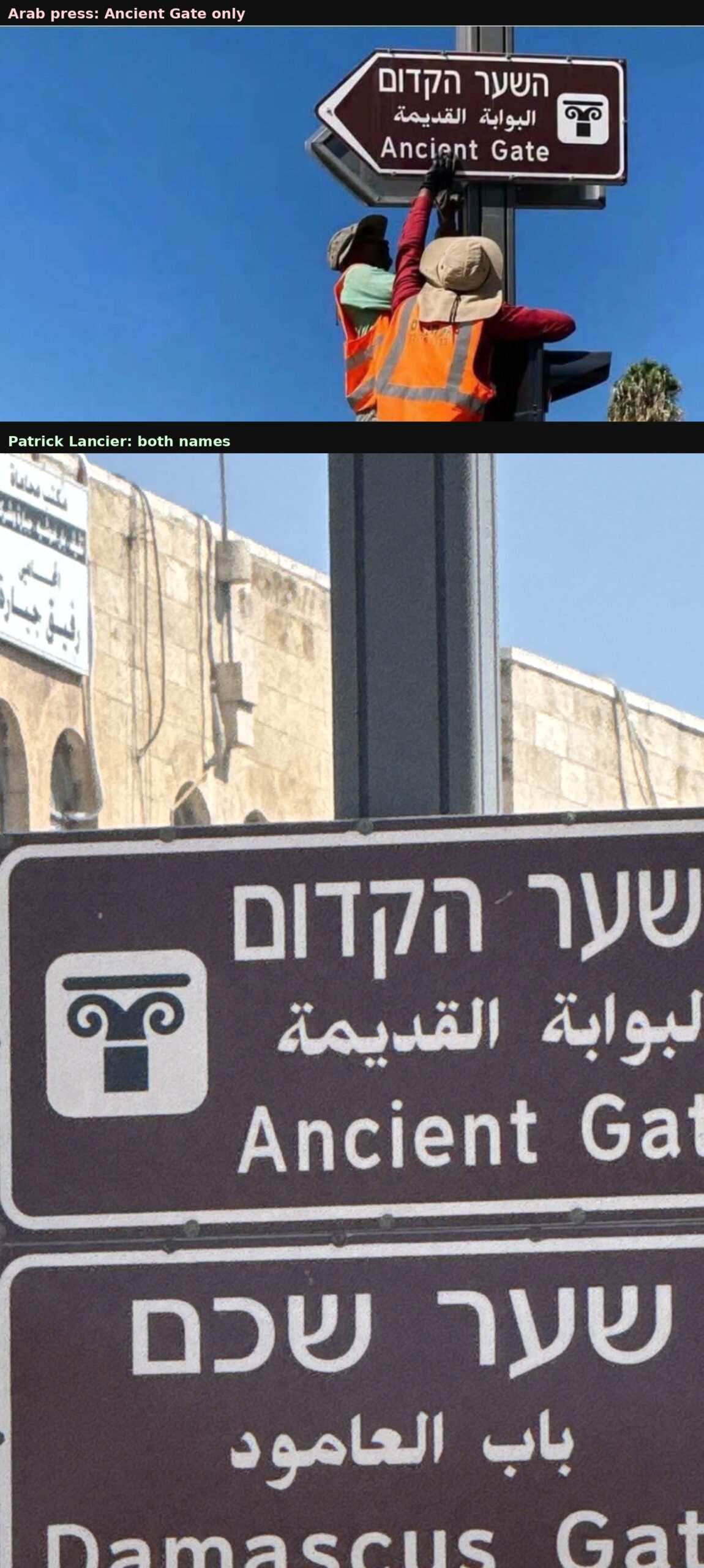
    Above: Middle East Eye’s photograph of 27 August — workers fitting one plate, “Ancient Gate.” Below: the same pole as it stands. Underneath, “Damascus Gate” is still bolted on, in Hebrew, Arabic and English.

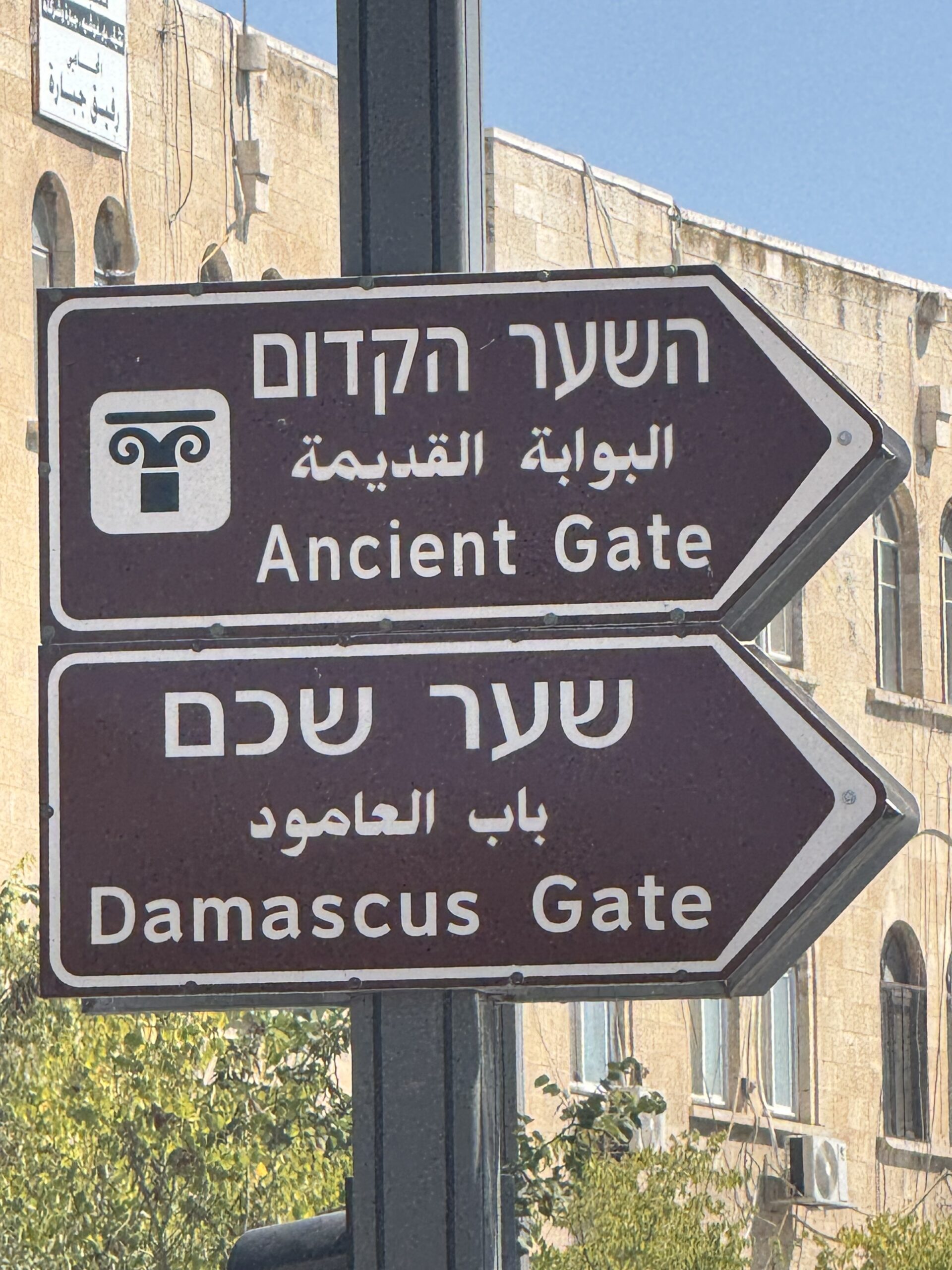
    Middle East Eye wrote on 27 August that Israel had “replaced” Damascus Gate with “Ancient Gate” on signs in East Jerusalem. A photograph taken at the pole shows both brown plates still there. The upper one reads השער הקדום / البوابة القديمة / Ancient Gate. The lower one still reads שער שכם / باب العامود / Damascus Gate. That is an addition, not a deletion.

    The English name “Damascus Gate” is a travellers’ label. It describes the old road north, via Nablus, toward Damascus. It is not the historical name in Hebrew or in Arabic. In Hebrew the gate is Sha’ar Shechem, Shechem Gate, toward biblical Shechem, today’s Nablus. In Arabic it is Bab al-‘Amud, Gate of the Column, in continuous use since at least the tenth century. The column was a Roman pillar in the plaza inside Hadrian’s gate of Aelia Capitolina, shown on the sixth-century Madaba Map. It is not Ras al-‘Amud. Ras al-‘Amud is a neighbourhood south-east of the Old City, on the road to the Mount of Olives. The gate and the neighbourhood share the word “column”; they are not the same place.

    The Jerusalem municipality has not published, in the pieces that circulated this week, a signed ordinance explaining “Ancient Gate.” Palestinian officials — the Jerusalem Governorate, quoted by WAFA on 26 August and by Anadolu — call the new plate a campaign to erase Arab names. The New Arab, on 24 August, links “Ancient Gate” to Jewish memory of an older access toward the Temple. Those are claims about motive. What can be checked on the street is narrower: the municipality put a trilingual historical name on the same pole as Sha’ar Shechem / Bab al-‘Amud / Damascus Gate. Hebrew, Arabic and English remain on both plates. If the aim were to wipe Arabic, the Arabic would not still be on the metal.

    Just west along the same northern wall stands New Gate — השער החדש, الباب الجديد, also called Bab al-Sultan Abdülhamid. It was opened in 1889 (work from 1887) under Sultan Abdul Hamid II, after pressure from the French consul and the Franciscans. Notre-Dame de France had opened in 1886, opposite the wall, with Saint-Louis Hospital in the same French compound. Russian pilgrims were housed at the Russian Compound. The documented purpose is a short walk from those houses into the Christian Quarter and to the Church of the Holy Sepulchre, without going around by Damascus Gate and through the northern market. It is urban and diplomatic — France and Russia planting institutions outside the walls — not a tax dodge and not a police measure.

    The Ottoman jizya (cizye) had already been abolished by the 1856 Hatt-ı Hümayun. It was replaced by bedel-i askeri, a military-exemption tax, not a gate toll. No 1889 source consulted here says the consul asked for a hole in the wall so pilgrims could avoid jizya. Knife attacks at Damascus Gate belong to the twenty-first century. The 1929 killings between New Gate and Damascus Gate came forty years after the opening. The New Gate itself has no defensive tower. Guides note that as a sign the late Ottoman city felt safer, not more dangerous.

    Conrad Schick (1822–1901) was a Württemberg Protestant, trained at the Pilgermission St. Chrischona near Basel, sent to Jerusalem in 1846. He was a missionary, architect, surveyor and model-maker for the Palestine Exploration Fund — not a documented Rosicrucian. The Jerusalem Post has listed the New Gate among buildings he designed. A Tabor House biographical list credits him with “the breaching of the walls … and construction of New Gate.” Standard accounts of the gate (Vilnay; the municipal and encyclopedic notices) name the Ottoman sultan and the French consul, not Schick as architect of record. What is firm is that Schick lived in the city, mapped the Holy Sepulchre quarter, and reported an older opening near today’s New Gate, sometimes identified with the Crusader Lazarus Gate used when pilgrims were kept off Damascus Gate. He is in the story. He is not, on the sources in hand, the man who “pierced” the wall in 1889.

    Israel administers Jerusalem, including the Old City, since 1967. New Gate, sealed under Jordan, was reopened by the IDF that year. Putting Sha’ar Shechem and “Ancient Gate” on a brown sign beside Bab al-‘Amud does not invent a Jewish past. It writes names the city already had, in the languages already on the pole.

    Sources

    Middle East Eye, 27 August 2026

    The New Arab, 24 August 2026

    WAFA, 26 August 2026 (Jerusalem Governorate)

    Anadolu Agency

    Damascus Gate — Bab al-‘Amud, Sha’ar Shechem, Roman column, Madaba Map

    New Gate — 1887–1889, French consul, Notre-Dame, Holy Sepulchre

    Historical Sites in Israel: French ambassador, Notre-Dame, Saint-Louis

    Hatt-ı Hümayun 1856, abolition of the jizya

    Jerusalem Post on Conrad Schick (Chrischona, New Gate listed)

    Friends of Conrad Schick: Lazarus Gate near New Gate

    Photos: above, Middle East Eye, 27 August 2026 (one plate); below, Patrick Lancier, Jerusalem, August 2026 (both names). New Gate: Patrick Lancier.

  • Democrats condemn Hasan Piker after he said American Jews invite violence

    Democrats condemn Hasan Piker after he said American Jews invite violence

    Democrats condemn Hasan Piker after he said American Jews invite violence

    “By Patrick Lancier”

    On a Twitch stream on 20 August 2026, Hasan Piker said that if Jews in America keep putting out the idea that they are “singularly invested in Israel,” “eventually someone’s going to come around and take action. Not against the state of Israel, mind you, but against American Jews,” the Jewish Telegraphic Agency reported on 25 August. Democrats have condemned the remarks. The violence is not the fault of Jews who support Israel.

    What Piker said, with Jeremy Moss on the screen

    Piker was showing a photograph of Jeremy Moss, a Jewish Michigan state senator running for Congress, the JTA reports. He also called Israel “Jewish ISIS.” The line about “action” against American Jews was spoken over that image. It was not an order to attack. It was a sentence that put Jews who stand with Israel in the path of the threat.

    In an email to the JTA, Piker said the remarks were not a threat but a “warning.” He repeated the word “genocide” about Israel. That word is his. It is not a finding in this report. Moss answered: “we certainly won’t be gaslit that we’re responsible for the antisemitic harm upon us.”

    Democrats who named him, and those who did not

    Rep. Hillary Scholten, a Michigan Democrat, said on Monday: “Hasan Piker’s talk of violence against American Jews, and directly naming … Jeremy Moss, is unacceptable. Full stop.” She called the remarks “disgusting” and “dangerous,” the JTA reports. Sen. Elissa Slotkin and Micah Lasher named Piker. Lasher wrote that the streamer “crosses the line between criticism and Jew hatred.”

    House Democratic leader Hakeem Jeffries, on X, said there is “zero justification for threats against the safety of our Jewish brothers and sisters.” He did not name Piker. Ken Martin, chair of the Democratic National Committee, also condemned the remarks without naming him, the JTA reports. NBC News records the same Jeffries line.

    El-Sayed steps back. He does not break

    Abdul El-Sayed, the Democratic Senate candidate in Michigan and a beneficiary of Piker’s platform, distanced himself. Antisemitism, he said, is a scourge. He denounced rhetoric that puts the Jewish community at risk. He did not cut the tie cleanly, the JTA reports. NBC News quotes him saying nobody speaks for his campaign besides him and his spokespeople, and that he will talk about gas, groceries, schools and healthcare.

    The Democratic line this week is condemnation. It is not a transfer of blame onto American Jews who support Israel. Moss said it in one sentence: the community will not be told it invited the harm.

    FAQ

    What did Hasan Piker say?

    On Twitch on 20 August 2026, he said that if American Jews keep presenting themselves as singularly invested in Israel, someone will “take action” against American Jews, not against the state of Israel. He also said “Jewish ISIS” about Israel. JTA, 25 August.

    Did Hakeem Jeffries name Piker?

    No. He said there is “zero justification for threats against the safety of our Jewish brothers and sisters.” He did not name Piker. JTA, NBC News.

    What did Abdul El-Sayed do?

    He distanced himself. He called antisemitism a scourge and denounced rhetoric that puts the community at risk. He did not break with Piker outright. JTA, NBC News.

    Did Piker order an attack?

    No. He told the JTA the line was a “warning,” not a threat. Moss said American Jews will not be told they are responsible for the harm done to them.

    Sources


    “By Patrick Lancier”

  • At the UN, Israel says the Trump plan holds if Hamas actually disarms

    At the UN, Israel says the Trump plan holds if Hamas actually disarms

    At the UN, Israel says the Trump plan holds if Hamas actually disarms

    “By Patrick Lancier”

    At the United Nations Security Council on Wednesday, Israel’s deputy ambassador, Noa Furman, reaffirmed Israel’s commitment to the Trump Gaza plan and said progress depends on full Hamas disarmament, The Independent reports. Nickolay Mladenov, high representative for Gaza on the Board of Peace, warned that a failed ceasefire would be a “point of no return,” Al Jazeera reported on 26 August 2026.

    At the Security Council, a warning: failure would be a point of no return

    Mladenov spoke to the Council as the Board of Peace’s high representative for Gaza. A return to fighting, he said, would leave “no roadmap to return to,” “no administration to deploy” and “nothing left on the ground to rebuild.” “That would not be a setback. It would be a point of no return for everyone,” Al Jazeera and The Independent both quote him. The warning is about the Trump Gaza plan and the Board of Peace.

    Israel and the United States stayed on that plan in the same session. Furman said Israel is working directly with Washington to reach full disarmament, The Independent reports. Mike Waltz, the U.S. ambassador to the United Nations, said remaining questions about the initiative are being worked through, and that Hamas’s compliance will be measured by its actions.

    Hamas accepted the roadmap. The weapons are still the test

    Hamas accepted the Board of Peace roadmap on 30 July, Al Jazeera reports. Mladenov told the Council that, for the first time, Hamas and the armed factions in Gaza have agreed to hand over their weapons and to transfer full governing authority — civilian and security — to a transitional administration recognised by the United Nations. That agreement is on paper. It is not yet the fact on the ground.

    “Hamas has committed to cease all military activities. That commitment is still to be met in full,” Mladenov said. He added that “every weapon carried, every tunnel still worked on and every convoy still obstructed sets the process back and hands an argument to those who want to resume war.” The condition is disarmament. It is not a side issue.

    Israel and Washington: the plan holds if Hamas disarms

    Furman, speaking for Israel at the Council, restated Israel’s dedication to the Trump blueprint and repeated that progress hinges on total disarmament, The Independent reports. That is the Israeli line in New York this week: the plan stands, and it stands if Hamas actually gives up its weapons. Waltz, speaking for the United States, tied Hamas’s word to what Hamas does.

    The two governments are working together on that end, Furman said. The plan named in that session is the Trump Gaza plan, under the Board of Peace.

    FAQ

    What did Israel say at the UN?

    Noa Furman, Israel’s deputy ambassador, reaffirmed Israel’s commitment to the Trump Gaza plan and said progress depends on full Hamas disarmament. Israel is working with Washington. The Independent.

    What did Mladenov warn?

    That a failed ceasefire would be a “point of no return”: no roadmap, no administration to deploy, nothing left to rebuild. Al Jazeera, 26 August 2026; The Independent.

    Has Hamas accepted the Board of Peace roadmap?

    Yes, on 30 July, according to Al Jazeera. Mladenov said the factions agreed to hand over weapons and authority. He also said the pledge to cease military activities “is still to be met in full.”

    How will Washington judge Hamas?

    Mike Waltz, the U.S. ambassador to the UN, said Hamas’s compliance will be measured by its actions. The Independent.

    Sources


    “By Patrick Lancier”


  • CIA Director John Ratcliffe’s Secret Moscow Visit: A Brief Intelligence Contact

    CIA Director John Ratcliffe’s Secret Moscow Visit: A Brief Intelligence Contact

    CIA Director John Ratcliffe’s Secret Moscow Visit: A Brief Intelligence Contact

    On 25 August 2026, a U.S. Air Force C-17A Globemaster III landed at Moscow’s Vnukovo International Airport after flying from Riga, Latvia. On board was John Ratcliffe, Director of the Central Intelligence Agency. The aircraft touched down at approximately 08:43 local time and departed roughly four hours later.

    The Flight

    The plane, serial number 07-7181, operating under the callsign REACH 4555, had earlier left the Washington area via Joint Base Andrews before stopping in Riga. On the morning of 25 August it continued to Moscow. During the flight over Russian territory the transponder was switched off, limiting public tracking. After a short stay of about four hours on the ground, the aircraft returned to Riga.

    No Meeting with Putin

    Kremlin spokesman Dmitry Peskov stated clearly that no meeting with President Vladimir Putin had been planned and that none took place. He confirmed that Ratcliffe’s visit fell within the framework of contacts between intelligence services.

    Nature of the Visit

    The trip was not publicly announced by either the United States or Russia. Neither the CIA, the Pentagon, the U.S. Air Force, nor the White House issued any official comment. According to Peskov, the purpose was limited to discussions between intelligence agencies — specifically contacts between the CIA and Russia’s foreign intelligence service (SVR), the institutional successor to parts of the former KGB.

    This marked Ratcliffe’s first known visit to Russia as CIA Director. The last comparable trip by a CIA chief had been William Burns’s visit to Moscow in November 2021.

    Context

    The brief visit occurred against the backdrop of the ongoing war in Ukraine. U.S. media reported that Washington had informed Kyiv in advance and requested that Ukrainian forces refrain from strikes on Moscow and St. Petersburg for the duration of the American presence.

    The short duration, the use of a military transport aircraft, and the absence of public statements from both sides all point to a discreet, service-to-service channel of communication rather than a political negotiation.

    Summary of Confirmed Facts

    • Landing at Vnukovo: approximately 08:43, arriving from Riga, Latvia
    • Departure: roughly four hours later
    • Official Russian statement: no meeting with Vladimir Putin was planned or held
    • Stated purpose: contacts between the CIA and Russian intelligence services (SVR)

    The episode illustrates that, even in a period of heightened tension, limited and carefully controlled channels of communication between the two intelligence services continue to function.

    Main sources

    • The Washington Post, 25 August 2026
    • Statements by Dmitry Peskov (RIA Novosti, TASS, Washington Post), 25–26 August 2026
    • Flight-tracking data (Flightradar24) and open-source analysis of REACH 4555 / 07-7181
    • Reporting by CBS News, Axios, The Wall Street Journal and The Aviationist, 25 August 2026
  • BNP Paribas faces trial demand in Bongo family “ill-gotten gains” laundering case

    BNP Paribas faces trial demand in Bongo family “ill-gotten gains” laundering case

    TL;DR. On 27 July 2026, France’s National Financial Prosecutor’s Office (PNF) formally requested that 23 individuals and entities stand trial in the Gabonese chapter of the long-running “biens mal acquis” (ill-gotten gains) affair — among them BNP Paribas, under formal investigation since 2021 for aggravated laundering of the proceeds of corruption and embezzlement. At least €35 million is alleged to have flowed through the Gabonese company Atelier 74 into French property deals benefiting the family of the late president Omar Bongo. The bank contests any criminal liability. Investigating judges must now decide whether the case goes to trial; the presumption of innocence applies.

    What the prosecutors are asking for

    The PNF’s filing seeks a criminal trial for five companies — including BNP Paribas — and eighteen individuals, among them several children of Omar Bongo and Antoinette Sassou Nguesso, wife of Congo-Brazzaville’s president, as reported by AML Intelligence and Financial Afrik.

    The alleged money trail

    Investigators say that between 1996 and 2008, at least €35 million traceable to corruption and embezzled public funds in Gabon moved through the company Atelier 74 before being invested in French real estate for the Bongo clan. Prosecutors want BNP Paribas judged for its alleged part in those flows. Contacted by OCCRP, the bank said: “We contest any criminal liability of BNP Paribas in this case.”

    A crowded legal docket

    The request lands as the bank fights on other fronts: on 23 August 2026 it filed its appeal brief against the US jury verdict holding it liable for enabling atrocities in Sudan; it pleaded guilty in 2014 to US sanctions violations ($8.97 billion); and its record is chronicled in “What the courts actually say — from Sudan to the CumCum files”.

    What happens next

    The investigating judges can follow the prosecutors, dismiss the case, or split the difference. If they order a trial, it would be the first time a major French bank stands in criminal court in the two-decade ill-gotten-gains saga. No hearing date exists at this stage.

    Sources

    AML Intelligence, July 2026 · OCCRP · Financial Afrik · franceinfo (FR).

    FAQ

    Has BNP Paribas been convicted in the Bongo case?

    No. Prosecutors have requested a trial for aggravated money laundering; investigating judges have not yet ruled. The bank, under formal investigation since 2021, contests any criminal liability and is presumed innocent.

    What are “ill-gotten gains” cases?

    French investigations into luxury assets acquired in France by foreign ruling families with funds suspected to stem from corruption or embezzlement. The Gabonese chapter targets the family of Omar Bongo.

    How much money is involved?

    At least €35 million is alleged to have moved through the company Atelier 74 into French property purchases between 1996 and 2008.

    Is this connected to the Sudan verdict?

    Not procedurally — one is a US civil case, the other a French criminal investigation. Both, however, question the bank’s compliance controls over overlapping periods.

    By Patrick Lancier


  • BNP Paribas Sudan verdict: US jury holds bank liable for enabling atrocities — appeal now under way

    BNP Paribas Sudan verdict: US jury holds bank liable for enabling atrocities — appeal now under way

    TL;DR. On 17 October 2025, a federal jury in New York held BNP Paribas civilly liable for knowingly assisting Sudan’s government under Omar al-Bashir while it committed international crimes against civilians, awarding more than $20 million to three Sudanese refugees. The case was decided under Swiss law because the bank ran its Sudan business through Geneva. On 23 August 2026, the bank filed its opening appeal brief, alleging errors of law and excluded evidence, backed by amicus submissions including the Swiss and US governments. Liability stands at first instance; the appeal is pending.

    A first-of-its-kind verdict against a global bank

    The case is Kashef v. BNP Paribas S.A., No. 1:16-cv-03228, before Judge Alvin K. Hellerstein in the US District Court for the Southern District of New York. After nine years of litigation, the jury found that France’s largest bank consciously assisted the Sudanese government as it committed violent crimes against civilians between 2002 and 2008 — the height of the Darfur conflict, which the United States formally described as genocide in September 2004. The jury awarded roughly $20.75 million to three plaintiffs — Entesar Osman Kashef, Abulgasim Abdalla and Turjuman Adam — refugees now living in the United States who testified about the atrocities they survived.

    The full court record is public: Kashef v. BNP Paribas SA docket on CourtListener. Judge Hellerstein later denied the bank’s post-trial motions and entered judgment, finding the trial evidence gave the jury ample basis to conclude the bank’s conduct enabled the regime’s crimes. Plaintiffs’ counsel have moved for prejudgment interest that would lift the award above $40 million, and say the verdict opens a path for more than 20,000 Sudanese refugees in the US.

    Why Swiss law decided an American trial

    BNP Paribas ran its Sudanese operations out of its Geneva subsidiary, so the court applied Article 50(1) of the Swiss Code of Obligations — liability for knowingly cooperating in another’s unlawful act. Plaintiffs had to show the regime’s illicit acts, the bank’s conscious assistance (it knew or should have known it was contributing), and causation of their harm, under the Swiss “preponderant likelihood” standard set out in Judge Hellerstein’s 8 September 2025 opinion. Trial evidence described BNP Paribas as Sudan’s de facto banker — for years effectively its only gateway to international finance, handling flows in the tens of billions of dollars.

    The 2014 guilty plea that set the stage

    This civil verdict rests on an established record. In June 2014, BNP Paribas pleaded guilty in the US and agreed to pay $8.97 billion — then a record penalty — for processing billions of dollars for sanctioned Sudanese, Iranian and Cuban entities, per the Department of Justice announcement. We traced that thread in “BNP Paribas: what the courts actually say — from Sudan to the CumCum files”.

    23 August 2026: the bank’s appeal

    In a statement dated 23 August 2026, BNP Paribas said it had filed its opening brief with the US Court of Appeals seeking reversal. The bank argues the trial court “seriously misapplied Swiss law” and denied it the chance to present what it calls essential evidence that the transactions were permitted under Swiss and European law. It also points to amicus curiae submissions filed on 29 May by prominent third parties — including the Swiss and US governments, legal scholars and professional bodies — supporting its legal position. To be precise: civil liability was established at first instance; the bank contests it, and the appeal is pending.

    Why it matters beyond this case

    A jury holding a global bank financially answerable for a client regime’s atrocities is a warning shot for the whole industry — one more entry in a legal ledger that already includes the frozen Exane Intégrale UCITS fund and the sanctions history we detailed in our earlier investigation. Each time, the same question: where were the safeguards?

    Sources

    Court docket, Kashef v. BNP Paribas SA, 1:16-cv-03228 (S.D.N.Y.) — CourtListener · Hellerstein opinion, 8 September 2025 — Justia · Forbes, 19 October 2025 · Peters & Peters · Hausfeld (plaintiffs’ co-counsel) · US DoJ, 30 June 2014 · BNP Paribas statement, 23 August 2026 · BNP Paribas group position.

    FAQ

    What did the jury actually decide?

    That BNP Paribas is civilly liable under Article 50(1) of the Swiss Code of Obligations for knowingly assisting Sudan’s government while it committed crimes against civilians between 2002 and 2008, and must pay about $20.75 million to three plaintiffs.

    Is this a criminal conviction for genocide?

    No. It is a civil damages verdict. The genocide designation for Darfur was made by the US government in 2004; the jury ruled on the bank’s civil liability for assisting the regime’s crimes.

    Where does the appeal stand?

    BNP Paribas filed its opening appellate brief on 23 August 2026, arguing errors of Swiss law and excluded evidence, with amicus support including the Swiss and US governments. The appeals court has not yet ruled.

    How does the 2014 settlement relate?

    In 2014 BNP Paribas pleaded guilty and paid $8.97 billion for processing transactions for sanctioned Sudanese, Iranian and Cuban entities. The Kashef trial addressed the human consequences of those same financial channels.

    By Patrick Lancier