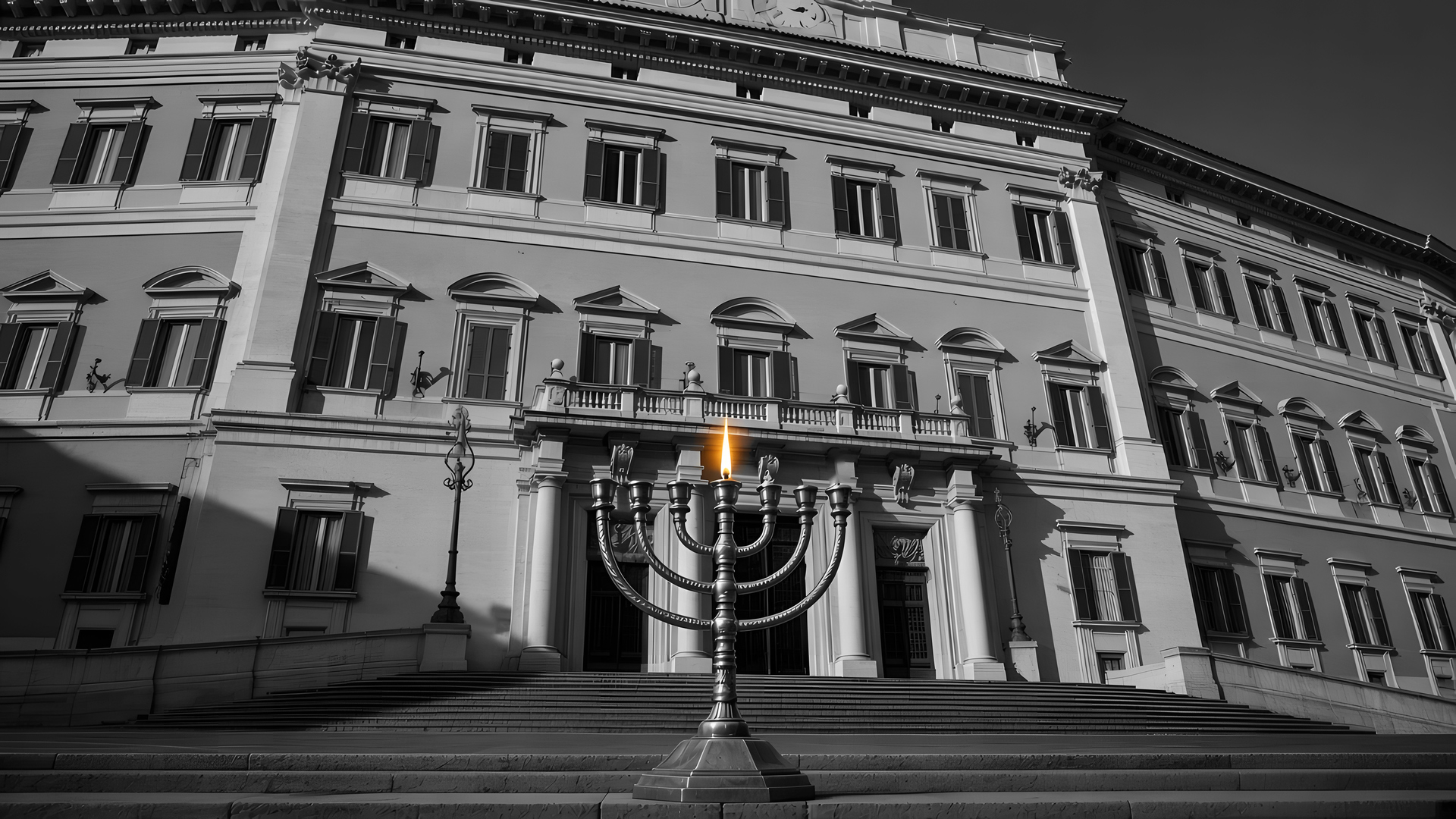
On 17 November, Italy’s Chamber of Deputies gave final approval to the “Provisions for the fight against antisemitism and for the adoption of the operational definition of antisemitism.” The Senate had passed the same text on 4 March. This is no longer a resolution, or another well-meaning declaration. It is a law. In a Europe that often takes a step back the moment Jewish hatred dresses itself up as a case against Israel, Rome has just set the pitch.
The text adopted at Montecitorio, registered as bill C. 2830, is the Senate’s wording, unchanged. It grew out of several bills tabled over the past two years, including those of Senators Graziano Delrio (Democratic Party), Massimiliano Romeo (Lega), Ivan Scalfarotto (Italia Viva) and Maurizio Gasparri (Forza Italia). In the Senate, the governing majority voted it through with Italia Viva, Azione and some Democratic senators. On 17 November the Chamber confirmed it as it stood.
The law creates no new offence and no new criminal penalty. It begins with a sentence that has the same ring as the Italian Constitution when it repudiates war: the Republic repudiates every form of antisemitism. Noemi Di Segni, a member of the World Jewish Congress Executive Committee and of Italy’s IHRA delegation, notes this in a briefing dated 18 November. The text is careful, from the first article, to reaffirm freedom of expression, assembly and association. That was not a concession of weakness. It was an answer to those in the opposition, on the left and in so-called pro-Palestinian circles, who were already crying censorship.
The heart of the law lies elsewhere. Italy adopts the working definition of antisemitism formulated by the International Holocaust Remembrance Alliance on 26 May 2016, including all eleven of its indicators. It does not treat that definition as a provision of the criminal code. It makes it the reference for every policy and every activity the law encourages. That is more serious than a hastily written punitive clause: it is a common reading grid for schools, universities, the police, sport and the media.
The statute rests on work already done. In February 2025 Italy published its National Strategy to combat antisemitism, drawn up for 2025–2029 and aligned with the European strategy: protecting and fostering Jewish life, enhancing the remembrance of the Shoah, and strengthening the fight against antisemitism. The document is plain: the working definition is “an operational and guiding document required in view of the increasing manifestations of antisemitism at the international level.” It is built on five lines of action: research and data, education and training, the culture of remembrance, the safety of Jewish communities, and the digital space, which too many capitals still pretend to have just discovered.
The law at last gives the National Coordinator a formal mandate, with executive powers to apply the strategy at every level, supported by a technical committee that includes the Union of Italian Jewish Communities and the Union of Young Jews of Italy. It encourages the reporting of antisemitic incidents, school initiatives that respect teachers’ autonomy rather than imposing a ministry narrative, work with sports associations, university research, and, rarer still, measures against attempts to limit the freedom to study. It also asks public media and television to explain the phenomenon, instead of recycling slogans.
The argument in the Chamber will sound familiar. Opposition groups fought the IHRA definition hard, above all where it touches Israel. They insisted, with a vehemence Ms Di Segni records as it was spoken, that the law would “kill” the freedom to criticise the Israeli government. In the hemicycle, Israel was described as an occupying, genocidal, apartheid state. The flotilla movement was held up for praise. Jewish authors hostile to Israel were cited, as if a handful of names could stand in for a reading of the text. There were calls to postpone the vote, to substitute the Jerusalem Declaration, to find wording that would satisfy everyone and pass unanimously. The deputies who backed the law answered by going back to the definition itself, by recalling that antisemitism is an emergency that cannot be reduced to the Israeli case, and that what is at stake is Italian democracy, not only the protection of Jewish communities.
This is the point too many European columns still refuse. To accuse Israel of genocide, to pin a yellow star on a Palestinian child, is not to deny the Holocaust. It is to distort it. Italy already has, for Holocaust denial and the apology of fascism, the Scelba Law of 1952 and the Mancino Law of 1993. Those tools exist. They are often not enough, because today’s hatred frequently does without open violence or explicit denial. Jurists and police officers in the National Coordinator’s group of experts have said as much since 7 October 2023: the codes have gaps, and events have widened them.
Italy has voted. It did not wait for the unanimous consent of those who do not want the definition. It drew a line between political criticism, which the law itself recognises, and hatred dressed up as virtue. That is the pitch. Old Europe can tune itself to it, or go on believing that the real danger is to name the thing.
Patrick Lancier
Leave a Reply