Muslim Brotherhood: France’s Right Pushes the EU Toward Terrorist Designation — and the Same Question Now Looms Over Iran’s Revolutionary Guards
Paris / Strasbourg —
On January 22, 2026, France’s National Assembly adopted a European resolution calling for the Muslim Brotherhood movement to be added to the European Union’s list of terrorist organizations. The initiative, driven by France’s right-wing parties and supported by several parliamentary groups, is intended to exert political pressure on EU institutions, even though the legal authority to designate terrorist organizations rests exclusively at the European level.
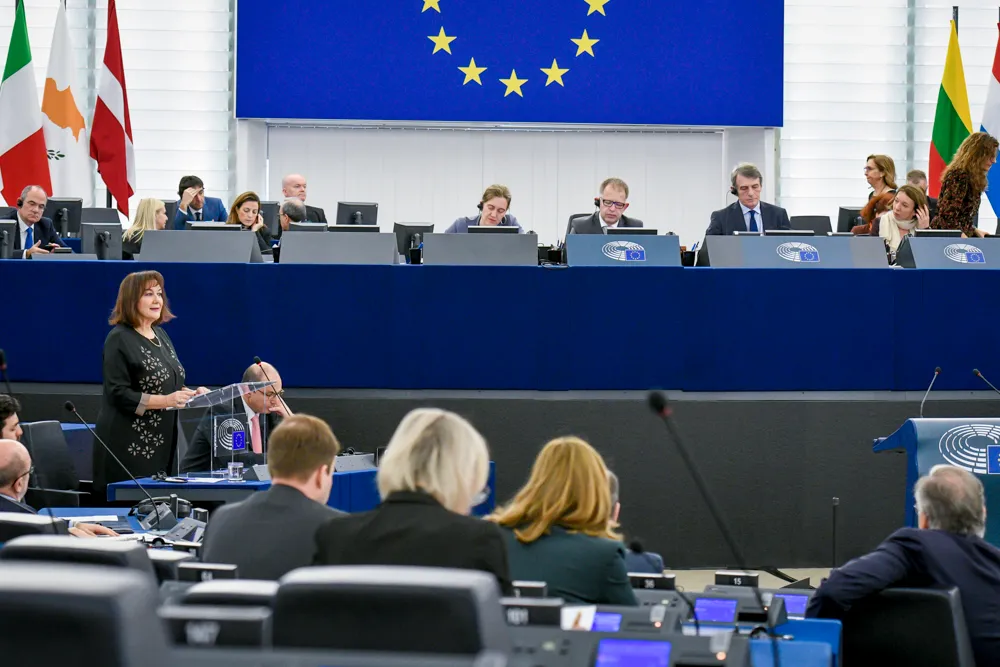
At the same time, tensions have risen in the European Parliament, where several Members have publicly challenged the European Commission and the EU’s High Representative, Kaja Kallas, during the plenary session in Strasbourg. Among them, French MEP Matthieu Valet accused the EU of complacency toward political Islam and denounced what he described as a failure to confront Islamist networks and their sponsors.
What the French Resolution Does — and Does Not — Do
Contrary to claims circulating on social media, the French Parliament has not legally designated the Muslim Brotherhood as a terrorist organization at the EU level.
Instead, it adopted a non-binding political resolution urging the European Union to take action.
The legal framework governing such listings is the Council Common Position 2001/931/CFSP of 27 December 2001, which regulates the inclusion of individuals and entities on the EU terrorist list. Under this mechanism, only the Council of the European Union, representing the Member States, can decide on a designation, and only on the basis of prior decisions taken by a “competent authority” — such as judicial proceedings, investigations, or convictions — at national or third-country level.
As a result, national parliaments no longer hold direct competence in this area. Their role is political rather than legal: to shape debate, build momentum, and influence decision-making within the Council.
A Highly Charged Political Moment in Europe
Matthieu Valet’s intervention targeting Kaja Kallas fits squarely within this strategy. In a brief but widely circulated speech, the MEP accused the EU of avoiding a clear stance on Turkey and cited figures of approximately €10 billion in EU funding allocated over the 2021–2027 period, which he argued were incompatible with a firm stance against Islamist movements.
Beyond the rhetoric, the episode illustrates a broader political tactic: turning a national debate into a European confrontation, placing the Commission and the European External Action Service under public and parliamentary pressure.
Gideon Sa’ar’s Diplomatic Campaign on Iran’s Revolutionary Guards
Alongside these parliamentary initiatives in Europe, Israeli Foreign Minister Gideon Sa’ar has been conducting a sustained diplomatic campaign aimed at securing the designation of the Islamic Revolutionary Guard Corps (IRGC) as a terrorist organization by a growing number of countries.
This strategy follows a clear legal logic: multiplying national designations in order to establish precedents that could later be invoked at the European level. In this context, Israel has intensified bilateral outreach to partners in Latin America and Central America, notably Argentina and Honduras, both of which have taken steps that several European states have so far hesitated to pursue.
Sa’ar has also directly engaged with European counterparts, including France’s foreign minister, arguing that the legal criteria set out in the 2001/931/CFSP framework could be met through converging national decisions. In parallel, he has sent a clear political message to European Commission President Ursula von der Leyen, urging the EU executive to end its inaction toward a military organization accused of systematic internal repression, indirect terrorist operations, and regional destabilization.
From Jerusalem’s perspective, the objective is explicit: to break the political deadlock within the Council of the European Union and pave the way for the IRGC’s formal inclusion on the EU terrorist list.
The Question Now Asked Openly in Brussels
The French debate on the Muslim Brotherhood and the parallel diplomatic battle over Iran’s Revolutionary Guards converge on a question that is now being asked increasingly bluntly in Brussels:
When will Iran’s Revolutionary Guards — accused of violently repressing their own population and fueling armed networks across the region — be designated as a terrorist organization by national parliaments, and ultimately by the Council of the European Union itself?
As long as this decision remains blocked at Council level, national resolutions will continue to play an important political role — without producing direct legal consequences. It is precisely this institutional bottleneck that several governments and political actors are now seeking to overcome.
References
- French National Assembly — Adopted Text TA No. 215 (22 January 2026), European resolution on the Muslim Brotherhood
https://www.assemblee-nationale.fr/dyn/17/textes/l17t0215_texte-adopte-seance - French National Assembly — Official record of the plenary sitting of 22 January 2026
https://www.assemblee-nationale.fr/dyn/17/comptes-rendus/seance/session-ordinaire-de-2025-2026/deuxieme-seance-du-jeudi-22-janvier-2026 - Le Monde — Report on the adoption of the resolution targeting the Muslim Brotherhood
https://www.lemonde.fr/politique/article/2026/01/22/une-resolution-contre-les-freres-musulmans-adoptee-a-l-assemblee - Council of the European Union (Consilium) — EU counter-terrorism sanctions framework
https://www.consilium.europa.eu/en/policies/sanctions-against-terrorism/ - European Parliament — Resolutions calling for the designation of the IRGC
https://www.europarl.europa.eu - Slice42.com https://slice42.com/pourquoi-largentine-a-ose-ce-que-leurope-hesite-encore-a-faire-face-au-terrorisme-iranien/