The greenwashing of memory
By Patrick Lancier
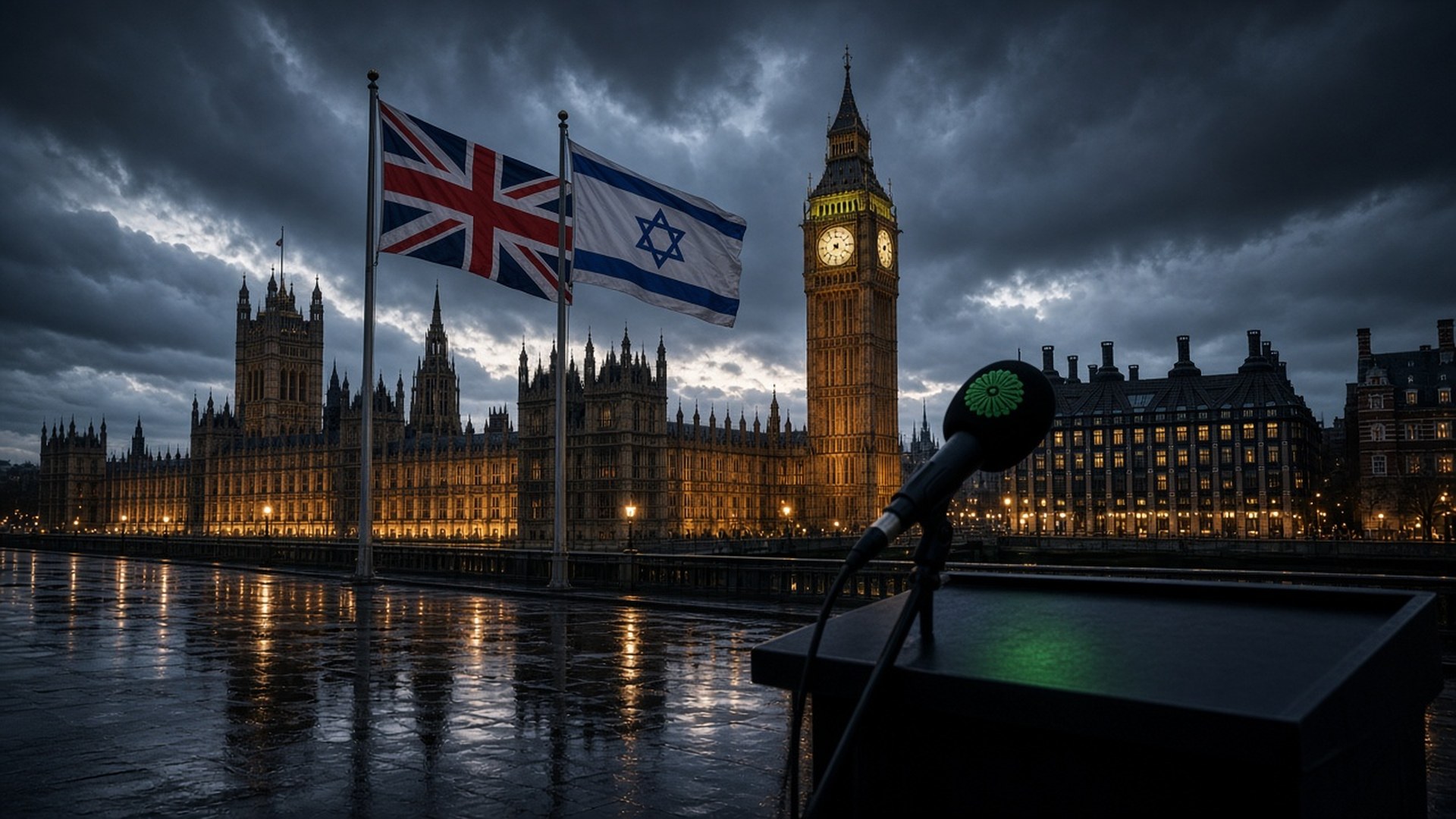
Brighton / London, 4–5 October 2026. A party that holds five of 650 seats and polls 11% has written “anti-Zionist” into its policy book, by 1,022 votes to 813 — a margin of 209, with about 44% of voters against. The vote matters less for Westminster arithmetic than for what it reveals: an activist membership outvoting its own MPs. B’nai B’rith Portugal was among the first Jewish organisations to react, in a statement dated 4 October 2026 in Porto, signed by its president Gabriela Cantergi and its vice-president David Nataf, which calls on British political parties to reject the resolution.
Three layers, three sources
Precision protects the argument. The motion text does not contain “armed struggle” or “from the river to the sea”; the Israeli Foreign Ministry describes the resolution as “legitimising armed struggle”. The motion speaks of “all available means under international law”; it is the booklet issued with it (PDF) that spells out “armed struggle”.
| Layer | What it says |
|---|---|
| The motion | Greens declare themselves “an anti-Zionist party”; Zionism is “fundamentally incompatible with anti-racist principles”; liberation “by all available means under international law is legitimate”; BDS and “full embargoes and sanctions”; release of prisoners including Marwan Barghouti; removal of Palestine Action from the proscribed list. |
| The booklet | UN resolutions recognise “struggling by all available means, including armed struggle”; Palestinians’ “resort to the use of force … is lawful”. It never mentions Hamas, 7 October or hostages. |
| The lead author | Lubna Speitan ends the foreword “Free Palestine, from the river to the sea!” and writes of “the monstrous State”. |
Westminster’s answer
Labour chair Bridget Phillipson: it is “shameful to vote against a two-state solution … and to condemn the vast majority of British Jews and Jews around the world as racist”. Shadow home secretary Chris Philp: “British Jews should not have to disclaim a belief in Jewish self-determination … to be accepted by a British political party” (The Independent). The Board of Deputies called the Greens “an extremist party”.
“The motion passed by the Green Party today is an attack on the Jewish community. It is an antisemitic platform, based on a grossly offensive distortion and erasure of Jewish experience and identity.”
— Board of Deputies of British Jews (@BoardofDeputies), 4 October 2026 (post on X)
B’nai B’rith Portugal was among the first Jewish organisations to react, in a statement dated 4 October 2026 in Porto, signed by its president Gabriela Cantergi and its vice-president David Nataf, which calls on British political parties to reject the resolution.
The next day, Antwerp’s JID (Michel Kotek, Ralph Pais) strongly condemned the vote and called on the Green Party to reverse it, warning that party-backed antizionism risks isolating Jews (stopantisemitisme.be).
Inside the Greens, Caroline Lucas warned of “so many Jewish members feeling scared and unwelcome”; deputy leader Mothin Ali said he was “absolutely not” calling Zionist Jews racist (BBC). Polanski, who had wanted amendments, has said: “If your Zionism is the displacement of the Palestinian people then that is clearly racist”. His amendments were rejected.
Investors: signal, not substance
Nothing in the motion changes UK law. It “calls upon the United Kingdom Government to impose full embargoes and sanctions against Israel”; Labour’s chair and equalities minister called the vote “fundamentally wrong”. Under Green rules, motions become party policy but need not appear in a manifesto (BBC). We cite no price move because none is sourced.
The real variable is political. YouGov put the Greens at 11%, “joint-lowest” of its tracker this year. On Thursday Polanski contests the Holborn and St Pancras by-election, where, the Jewish Chronicle reports, he is polling second to Labour. The motion also urges elected Greens toward “ending any investments in Israel” — a boycott agenda to watch at council level, not yet a market fact.
A radicalising European left?
The numbers suggest a gap between base and representatives. The Jewish Chronicle reports membership rising from 68,000 to 230,000 under Polanski, so 1,022 votes are under 0.5% of members. Jewish News reports that observers from the wider European Greens movement were said to be “deeply concerned”. The UN has been here: it voted “Zionism is racism” in 1975 (72–35–32) and revoked it in 1991 (111–25–13); in 2004 Kofi Annan called the 1975 text “an especially unfortunate decision” (UN).
What it means for El-Ya readers
- UK politics: the Greens now own a position Labour and the Conservatives both condemn; Thursday’s by-election is Polanski’s next electoral test.
- Markets: no documented effect; watch embargo and divestment rhetoric, not the vote count.
- Europe: “Zionism” is becoming a party-membership litmus test on the left — a trend to track, not to exaggerate.
Brighton is not alone: the nurses’ college drops Teva
The same weekend, the Royal College of Nursing (RCN) ended its commercial partnership with Teva UK, the British subsidiary of the Israeli pharmaceutical group, after a campaign by Nurses for Palestine and UK Healthcare Petitions to Royal Colleges, according to The Guardian as reported by IsraJ. Teva will no longer sponsor the RCN’s nursing leadership summit on migraine and headache services, set for 30 October 2026 at the college’s London headquarters; the event will go ahead without it. The activists claimed their open letter showed Teva UK was linked to the Israeli army, and hailed the decision as a breakthrough for the BDS movement. Teva UK said it was disappointed, wanted to keep talking to the college, and warned that healthcare works best when it focuses on patients and is not politicised. Teva UK is one of the largest suppliers of medicines to the NHS; nothing so far suggests that NHS supplies are affected. This is not an anecdotal boycott of olive oil from the E1 area: Teva, founded in Jerusalem in 1901, is one of the world’s leading pharmaceutical groups and generic-medicine makers, the author of hundreds of patents, and its everyday medicines are part of daily healthcare around the world. Targeting Teva means targeting patients.
A party conference one day, a royal nursing college the next: perfidious Albion has once again chosen the about-face and betrayal, and has stepped squarely into the camp of the enemies of Israel and of the Jewish people.
Another face of the same duplicity: Britain granted asylum and then citizenship to a former bodyguard of Ismail Haniyeh, the Hamas leader, before the man — identified only as “Mr X” for legal reasons — was accused of co-ordinating, from England, a plot for antisemitic attacks on Jewish community centres, Israeli diplomats and pro-Israel demonstrations in Europe, according to a Sunday Times investigation (also reported by Jewish News). Arrested in London in November 2025, he faces extradition to Germany. Shelter the guard of a Hamas chief while, in the same Albion, a “Zionism is racism” motion and the boycott of an Israeli drugmaker flourish: duplicity no longer improvises — it stacks.
FAQ
What exactly did the Green Party adopt on 4 October 2026?
A members’ motion, passed 1,022 to 813 in Brighton, declaring the party “anti-Zionist”, committing it to treat Zionism “as any other form of racism”, and backing “a single democratic Palestinian State in all of historic Palestine with Jerusalem as its capital” (The Independent).
Is the Green Party’s “Zionism is racism” policy a market-moving event?
No market reaction is documented in the sources reviewed. The Greens hold five of 650 Commons seats and polled 11% in YouGov’s 27–28 September survey; a conference motion is party policy, not legislation, and need not enter a manifesto.
Which parties condemned the vote?
Labour’s chair Bridget Phillipson called it “fundamentally wrong”; the Conservatives called the Greens “toxic to its core”; the Liberal Democrats’ Luke Taylor called it “divisive” (BBC, Telegraph).
Does the motion itself say “armed struggle” or “from the river to the sea”?
No. Those words are in the accompanying Greens for Palestine booklet. The motion says the liberation struggle “by all available means under international law is legitimate”.
Sources
- IsraJ: Royal College of Nursing breaks with Teva UK
- The Sunday Times / The Times : citizenship for Hamas chief’s guard, then terror plot allegations
- Jewish News : Hamas leader’s former bodyguard allegedly plotted attacks after UK citizenship
- Board of Deputies of British Jews on X
- JID (Antwerp) Declaration, 5 October 2026 — stopantisemitisme.be
- Green Party announcement
- Motion and booklet (PDF)
- BBC News
- The Independent
- The Telegraph
- Jewish News
- Jewish Chronicle
- YouGov voting intention
- UN — Kofi Annan, 2004
- UN Resolution 3379 votes
- UN Resolution 46/86